Codex vs Claude Code vs Cursor: The AI Coding Agent Battle Is Moving Beyond Developers
Compare Codex, Claude Code, and Cursor from the perspective of the new AI coding agent market. This guide explains why the battle is no longer only about autocomplete or developer productivity, but about long-running agents, agentic IDEs, cloud execution, terminal control, knowledge work, workflow automation, and non-developer work products. It also explains what founders, creators, consultants, agencies, product teams, and businesses should learn from the shift toward AI agents that can build software-shaped outputs, automate work, and support SEO, GEO, content systems, showcase websites, and lead generation.
Codex vs Claude Code vs Cursor: The AI Coding Agent Battle Is Moving Beyond Developers
The old AI coding race was easy to understand. One tool wrote code faster. Another explained errors better. Another helped autocomplete a function before you finished typing.
That race still exists, but it is no longer the most interesting part.
The real battle between Codex, Claude Code, and Cursor is moving beyond developers. These tools are becoming work systems. They do not only help engineers write code. They help teams create software-shaped outputs: scripts, reports, dashboards, workflows, internal tools, automated checks, content pipelines, SEO pages, data analysis, and business operations.
That shift matters because software work is no longer limited to software teams. A founder wants a landing page and a reporting dashboard. A consultant wants a spreadsheet model and a client-facing memo. A marketer wants SEO pages, GEO-ready content, analytics scripts, and publishing workflows. A creator wants a website, a newsletter system, a lead magnet, and a simple database.
The coding agent battle is becoming a battle for who owns the work loop: the place where ideas become files, files become products, and products become business outcomes.
Why this comparison matters now
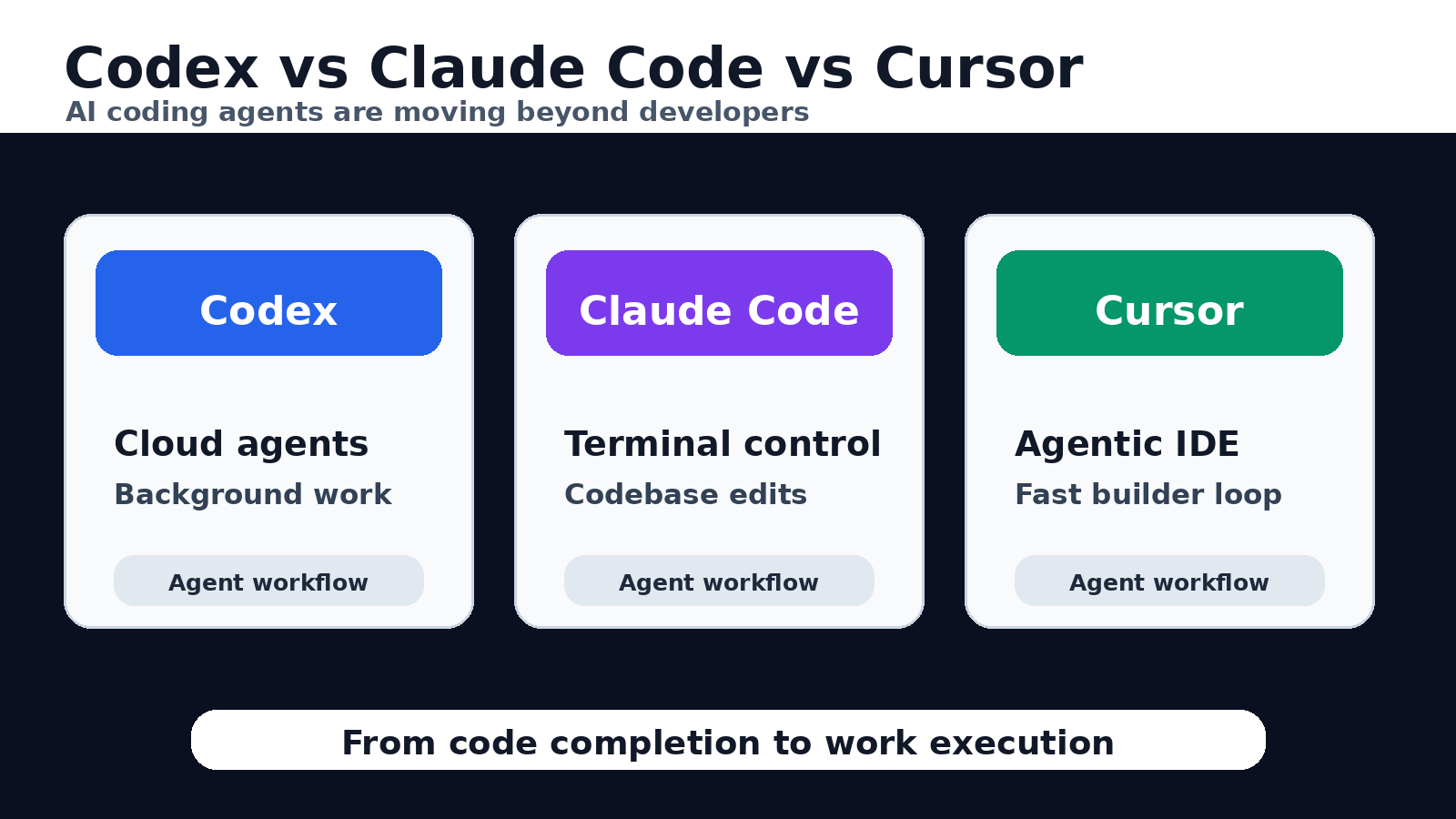
Codex, Claude Code, and Cursor are not just three ways to write code. They represent three different directions for the AI agent market.
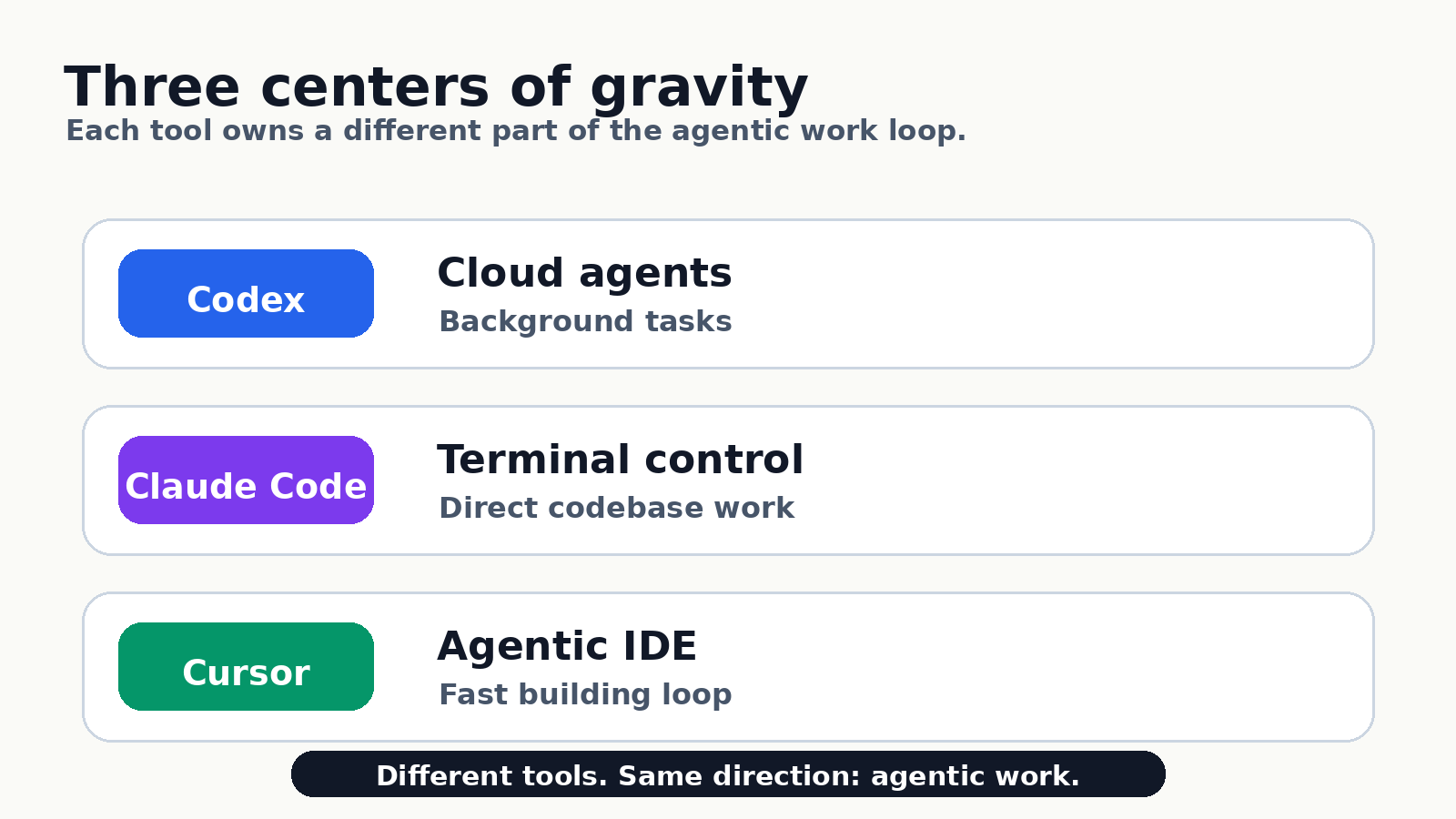
Codex is pushing toward cloud-based agent infrastructure. OpenAI describes the Codex app as a command center for agentic coding, with worktrees and cloud environments where agents can work in parallel across projects. OpenAI has also positioned Codex as a productivity tool for knowledge work, not only software engineering.
Claude Code is strongest when the user wants direct control inside the codebase. Anthropic describes it as an agentic coding tool that reads your codebase, edits files, runs commands, and integrates with terminal, IDE, Slack, and web workflows. It feels closer to a powerful terminal coworker.
Cursor is building the agentic IDE. Its product pages frame Cursor as a coding agent for building software, while recent Cursor releases emphasize agents that can start from GitHub, Slack, Linear, JetBrains, and more. Cursor 3 pushes toward a unified workspace for building software with agents.
So the question is not simply which tool writes better code. The better question is: which workflow becomes the operating system for agentic work?
Codex: the cloud-agent infrastructure play
Codex is becoming bigger than a coding sidebar. Its strongest strategic signal is infrastructure: cloud environments, worktrees, parallel tasks, and long-running workflows.
That matters because serious work requires more than a clever model. It needs a place to run. It needs repositories, files, tools, permissions, test commands, logs, and review states. If an AI agent is going to build real work products, it cannot only chat about the work. It has to execute parts of the work in a controlled environment.
This is why Codex is interesting beyond developers. A coding agent that can run tasks in a cloud environment can also become a general work agent when the work has a software-shaped component. Reports need data scripts. Dashboards need queries. SEO content systems need templates, crawlers, metadata, and publishing logic. Operations teams need automations. Founders need prototypes. Codex points toward that larger execution layer.
The risk is that Codex may feel less immediate for people who live inside a local IDE all day. But for teams that want background work, parallel execution, and controlled environments, Codex has a strong strategic position.
Claude Code: the terminal-first control layer
Claude Code feels different. It is not trying to be only a cloud command center. Its identity is closer to direct, local, codebase-aware work.
Anthropic says Claude Code can read the codebase, edit files, run commands, and help developers ship from terminal, IDE, Slack, or the web. The important detail is control. Developers can see what is happening, approve actions, and keep the agent close to the environment where real engineering work happens.
This makes Claude Code powerful for engineers who want depth. It is useful when the work requires reading many files, changing multiple places, running commands, debugging failures, and staying close to the project. It also appeals to teams that do not want every step abstracted away behind a remote workspace.
For non-developers, Claude Code is still less approachable than a polished business workflow tool. But that may change as agent interfaces become simpler. If a consultant, operator, or founder can describe a task and Claude Code can safely operate across files and tools, the boundary between developer and non-developer starts to weaken.
Cursor: the agentic IDE for fast builders
Cursor is strongest as an interface. It is not just a model or a command-line tool. It is an AI-native coding workspace.
Cursor's product direction is clear: keep builders inside an IDE where agents can plan, edit, review, and hand off work. Cursor 3 describes a unified workspace for building software with agents, with clearer visibility into what agents produce and handoff between local and cloud agents. Cursor's Composer model line also shows its focus on low-latency agentic coding and fast iteration.
That makes Cursor attractive for builders who want speed. The user can stay close to the code, watch the agent work, intervene quickly, and iterate without switching tools. For startups and product teams, this matters because the loop between idea, implementation, and review is often the bottleneck.
The challenge for Cursor is expansion beyond the developer interface. If the future market includes marketers, founders, consultants, and operators, an IDE is both strength and friction. Cursor owns the builder workflow. The next question is how far that workflow can stretch into business work that looks like software but is not traditional engineering.
Why the battle is moving beyond developers
The phrase AI coding agent is already becoming too narrow. These systems are called coding agents because code is where execution is easiest to measure. A test passes or fails. A pull request can be reviewed. A bug is fixed or not fixed.
But the same agent pattern applies to knowledge work. A report can be drafted, checked, formatted, and updated. A spreadsheet can be cleaned, modeled, and explained. A website can be generated, optimized, and published. A content system can be planned, written, illustrated, and structured for SEO and GEO.
This is why the market is expanding. Developers are the first users because they already understand files, workflows, version control, and automation. But non-developers also have file-based work. They just do not always call it software.
The winning agent may not be the one that writes the cleverest function. It may be the one that helps people turn messy work into finished assets with the least friction.
What this means for businesses and creators
For businesses, the implication is simple: do not think of coding agents only as engineering tools. Think of them as work-product engines.
A founder can use them to build prototypes, landing pages, analytics dashboards, customer research summaries, pricing experiments, and internal automations. A consultant can use them to create client reports, workflow tools, data models, and proposal systems. A creator can use them to build a personal site, content tools, email capture flows, and productized templates.
This is directly connected to We0.ai's world. A showcase website is no longer just a design asset. It can become part of a larger agentic work loop: build the site, showcase the offer, generate SEO pages, structure GEO-ready content, create visuals, track leads, and keep improving the system.
The future is not one tool doing everything. It is a set of agents and platforms working together around business outcomes.
Quick comparison table
Tool | Center of gravity | Best fit |
Codex | Cloud agents, worktrees, parallel execution | Teams that want background tasks, multi-agent workflows, and knowledge-work expansion |
Claude Code | Terminal, IDE, local codebase control | Developers who want deep codebase work, command execution, and direct file edits |
Cursor | Agentic IDE, Composer, local and cloud agents | Builders who want speed inside a coding workspace with agent visibility |
Main shift | From completion to execution | The battle moves beyond developers when agents create work products |
Decision framework: which one should you care about?
If you are an engineering-heavy team, the decision may come down to workflow preference. Codex is compelling when you want cloud-based parallel work and background agents. Claude Code is compelling when you want terminal-first control and deep codebase interaction. Cursor is compelling when you want an AI-native IDE built for fast iteration.
If you are a founder, creator, marketer, or consultant, the decision is different. You may not need to pick a coding tool as your main workspace. Instead, you should understand what each direction signals.
Codex signals that agents are becoming persistent cloud workers. Claude Code signals that agents can operate close to real files and commands. Cursor signals that the workspace itself is becoming agentic. Together, they show where all knowledge work tools are heading.
The bigger shift: from tools to work loops
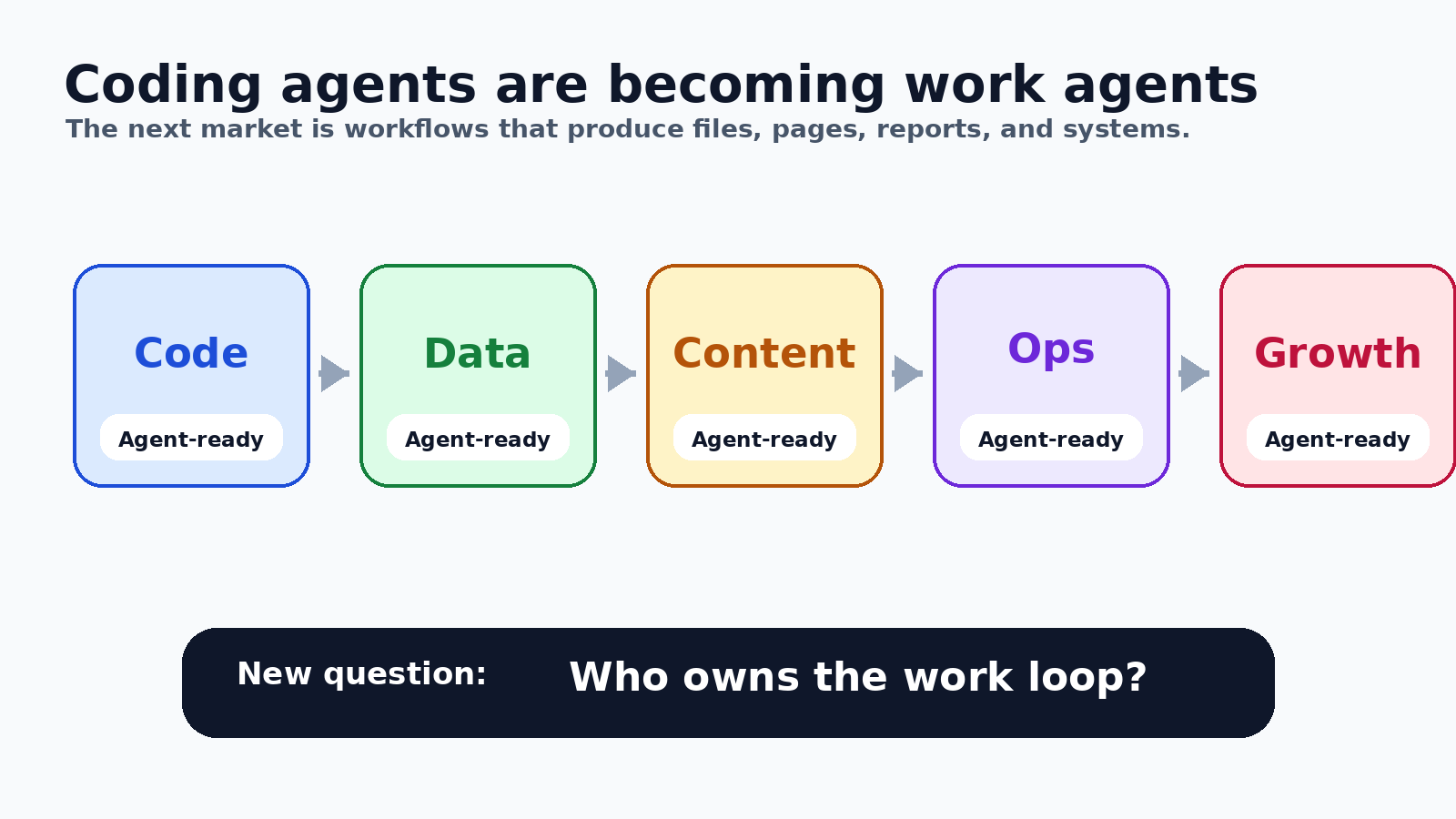
The old software market sold tools. The new agent market sells work loops.
A work loop includes context, planning, execution, review, correction, and publishing. The more of that loop an AI system can own, the more valuable it becomes. That is why the battle is not only about developers. Everyone has work loops.
SEO teams have research, writing, editing, formatting, image creation, linking, publishing, and performance updates. Sales teams have research, outreach, CRM updates, follow-up drafts, and proposal documents. Operations teams have data cleaning, reporting, monitoring, and automation. Founders have everything at once.
Coding agents are becoming the first visible form of a broader category: agents that turn intent into useful assets.
Final takeaway
Codex, Claude Code, and Cursor are fighting for the next layer of productivity. Codex is strongest as a cloud-agent infrastructure bet. Claude Code is strongest as a terminal and codebase control layer. Cursor is strongest as an agentic IDE and builder workspace.
But the larger shift is more important than the individual winner. The market is moving from code completion to agentic work execution. That means the next generation of tools will not only help developers. They will help knowledge workers create software-shaped outputs without becoming full-time engineers.
For We0.ai and showcase website growth, this is a major signal. The future of website building is not only page generation. It is an agentic growth system: Build, Showcase, Grow, and Leads. Coding agents are showing the pattern first. The rest of knowledge work is next.
CTA
If your website and content operation still depend on one-off manual work, the next step is structure. Build a showcase website and content system that can support SEO, GEO, AI search visibility, and lead generation as one connected work loop.
Build with We0.ai
FAQ
What is the difference between Codex, Claude Code, and Cursor?
Codex is moving toward cloud-based agent infrastructure, Claude Code focuses on terminal and codebase control, and Cursor is building an agentic IDE workspace.
Is the AI coding agent battle only for developers?
No. Developers are the first users, but coding agents are expanding into knowledge work, workflow automation, websites, reports, data analysis, and content systems.
Why is Codex important beyond coding?
Codex is being positioned by OpenAI as useful for knowledge work, including documents, reports, updates, research, analysis, and automation.
Why is Claude Code different?
Claude Code runs close to the codebase and can read files, edit files, run commands, and work through terminal and IDE workflows.
Why is Cursor important?
Cursor owns the agentic IDE workflow, where users can build, review, and iterate with agents inside a coding workspace.
How does this relate to We0.ai?
It shows the broader shift from one-off generation to agentic work systems, which is relevant to showcase websites, SEO, GEO, and lead-generation workflows.
Related Tools
- Codex
- Cursor
- ChatGPT
- SEO Tool
Sources
- Codex
- Cursor
- Cursor 3