Claude Tag in Slack: AI Moves From Private Chat to Shared Team Workflow
A practical rewrite and analysis of Anthropic’s Claude Tag launch inside Slack, explaining why @Claude is more than a chatbot and how it turns AI into a visible workplace teammate. The article covers Slack workflows, shared context, admin controls, Gmail-style alerts, enterprise adoption, AI search, and how We0.ai connects this shift to showcase website growth.
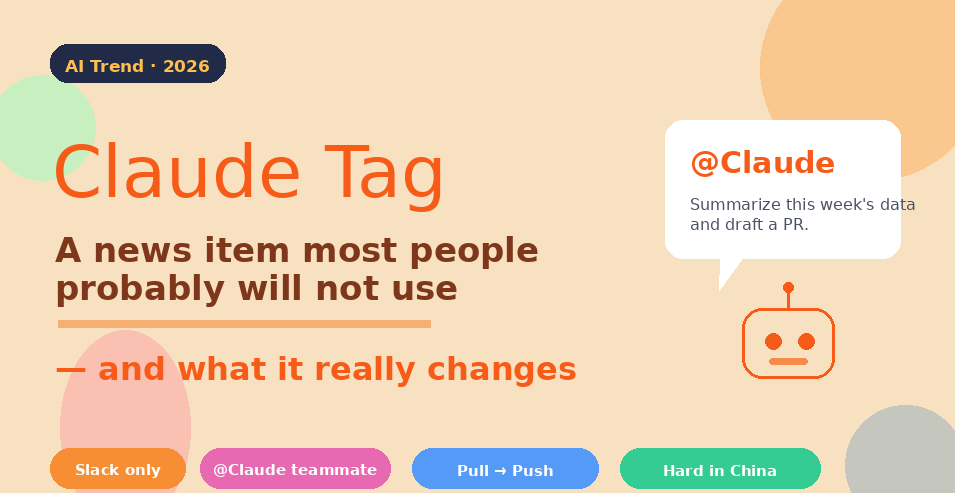
Original article illustration with English text: Claude Tag becomes an AI entry point inside the team workflow
When most people hear “AI assistant,” they still imagine a private chat window. You ask. It answers. You copy the result back into your real work tool.
Claude Tag changes the form factor. It places Claude inside Slack threads, so a team can mention @Claude the same way they would mention a coworker. The AI can read the surrounding context, break down work, summarize progress, and surface relevant updates later.
That may sound like just another Slack integration. The deeper shift is different: AI is moving from a private tool into a visible role inside team collaboration.
For companies, that matters more than “another chatbot.” The most important workplace context usually does not live inside a clean prompt. It lives across Slack threads, email, docs, tickets, repositories, and meetings.
The core point: Claude Tag is about visible collaboration
Older AI assistant pattern | Claude Tag pattern |
One user chats privately with AI | A team mentions @Claude in a shared thread |
People copy context manually | AI reads approved conversation context |
The answer ends the session | The agent can retain context and watch for later updates |
People manually repost the result | Summaries and action items stay in the workflow |
Permission boundaries feel vague | Admins control channels, data, and tool access |
The key question is not whether Claude can write a good answer. The key question is whether AI can become visible, callable, and trackable inside the team’s existing workflow. That is what turns a private assistant into an AI teammate.
What can Claude Tag do?
According to public reporting, Claude Tag can be mentioned inside Slack threads, read the relevant conversation, break down tasks, and proactively flag important updates across an organization. It is currently in beta for Claude Enterprise and Claude Team customers, with plans to expand to other platforms.
You can think of the product in three layers.
Layer | Value for the team |
Context reading | The team does not need to explain the whole background again |
Organization | Long threads become summaries, tasks, risks, and next steps |
Follow-up | Important emails, discussions, or updates can return to Slack as alerts |
But the reality is also restrictive: the number of people who can truly use Claude Tag today is smaller than the headline makes it sound.
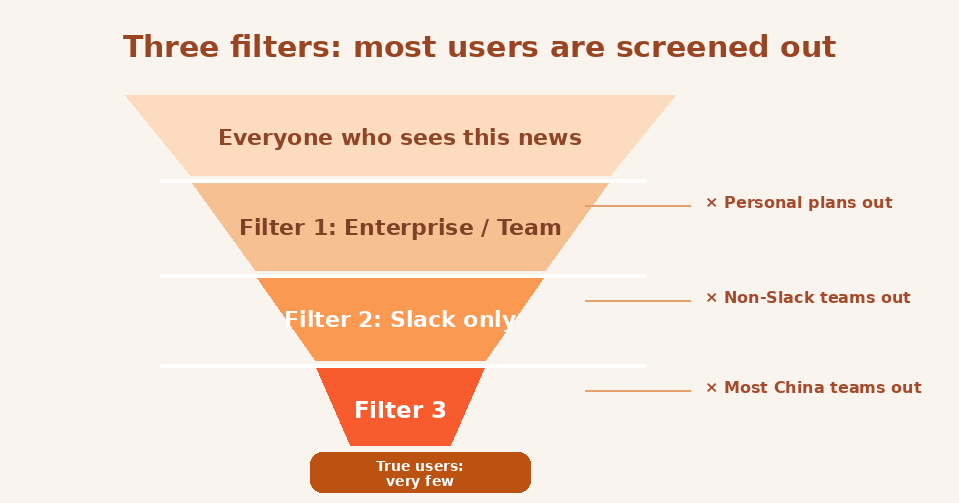
Original article illustration with English text: adoption is filtered by plan, platform, and regional reality
That image captures the short-term reality well. Claude Tag signals where workplace AI is heading, but the teams that can fully benefit first are those already working deeply inside Slack and already paying for Enterprise or Team plans.
Why Slack is a critical entry point
In many companies, real work does not begin in polished documents. It starts in chat. Requirements appear in Slack, bugs are first discussed in Slack, customer feedback is forwarded into Slack, and meeting decisions often land in a thread before they become formal documentation.
If AI stays inside a separate app, it always starts with incomplete context. Humans must keep moving information around.
Claude Tag reverses the flow: AI moves to where the context already exists.
That matters for enterprise AI because the next competition is not only model capability. It is who can enter the team’s actual workflow.
What Claude Tag says about future AI workflows
Claude Tag points toward a larger pattern: AI is moving from single-purpose tools into collaborative environments.
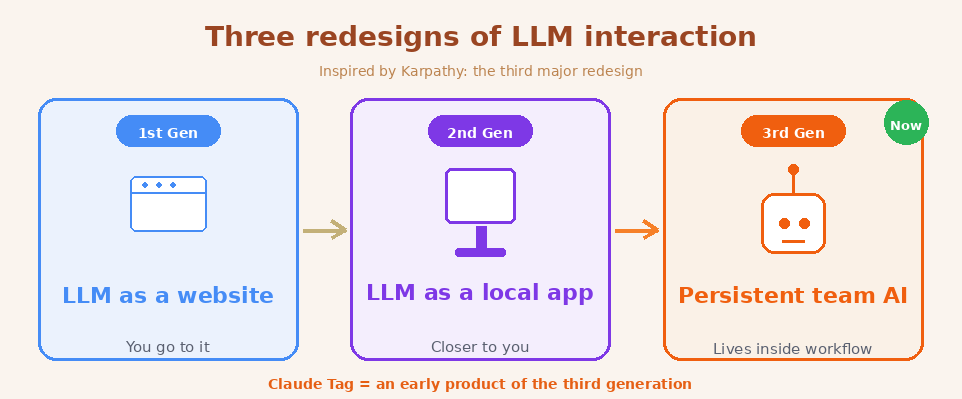
Original article illustration with English text: from website AI, to local app AI, to persistent team AI inside the workflow
• Instead of opening a new window, teams summon AI inside the existing conversation.
• Instead of rewriting the prompt every time, AI inherits the thread context.
• Instead of one person working privately with AI, the team can see and evaluate the output together.
• Instead of generating a paragraph, AI creates summaries, action items, alerts, and next steps.
This shift will affect team chat, project management, CRM, support, code collaboration, docs, and even websites and content operations.
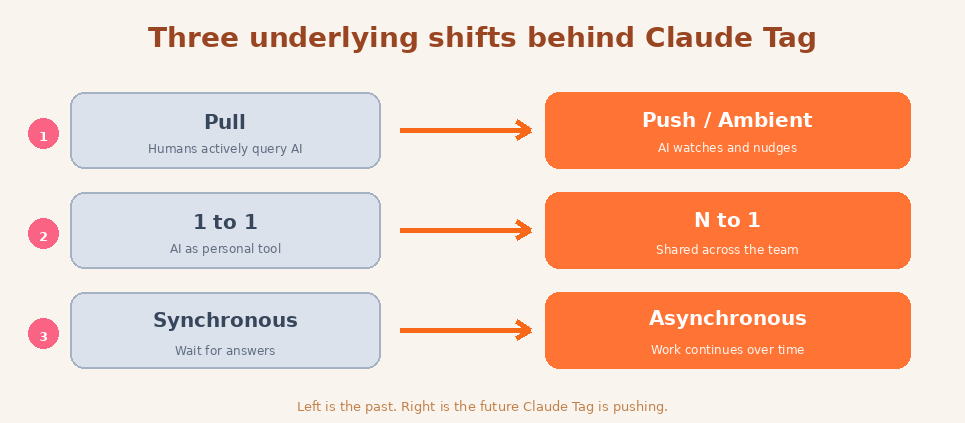
Original article illustration with English text: the real shift is from pull to push, from 1-to-1 to N-to-1, and from synchronous to asynchronous work
Permissions and control decide whether enterprises can use it
Putting AI inside Slack immediately raises a harder question: what can it read, which channels can it access, can it connect to Gmail, can it see customer information, and who decides?
A major part of Claude Tag’s enterprise value is admin control. Public reporting says administrators can tightly control what data and tools Claude Tag can access in each channel.
This is essential. Companies do not only worry that AI is powerful. They worry that AI power has no boundary.
If an AI teammate can read conversations, review email, and connect to tools, it needs permissions, logs, and auditability. Without those, it is unlikely to become part of serious organizational work.
Where We0.ai fits into this shift
Claude Tag is about the internal collaboration entry point. We0.ai is about the external showcase and growth entry point. They look like different categories, but the underlying logic is similar.
Companies do not need “one more AI tool.” They need a complete chain: information enters a system, gets structured clearly, becomes understandable to humans and AI systems, and turns into visible business assets.
We0.ai is positioned as Build & Growth For Showcase: an AI Showcase Website Growth Platform. It is not just a page generator. It helps products, brands, services, case studies, and portfolios move through Build → Showcase → Grow → Leads.
If Claude Tag helps internal information become clearer, We0.ai helps turn that clarity into public websites, case pages, FAQs, SEO/GEO content, and lead-capturing pages.
How should companies evaluate Claude Tag-like products?
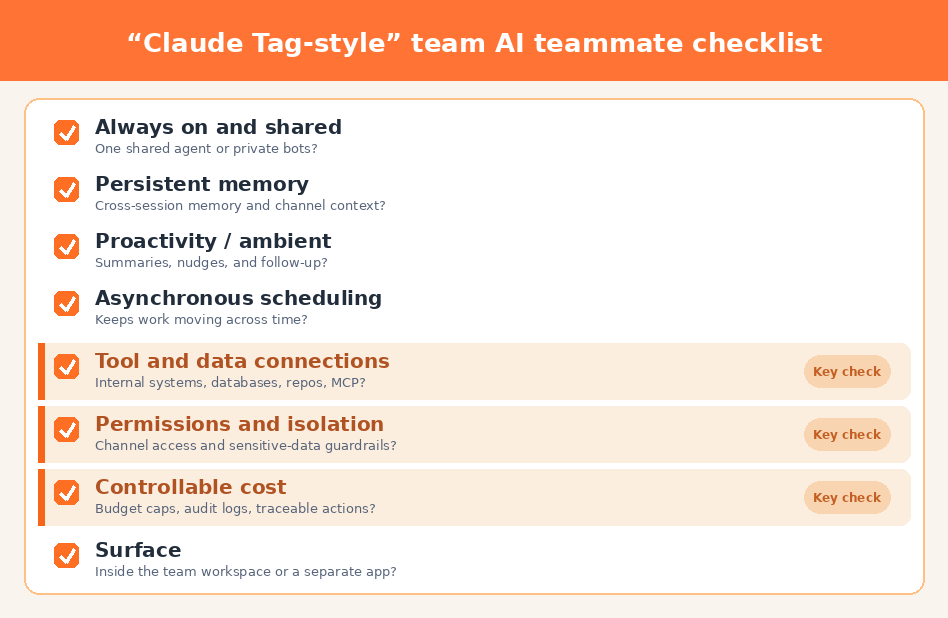
Original article illustration with English text: evaluate team AI on memory, proactivity, permissions, tool connection, and controllable cost
Evaluation point | Question to ask |
Context ability | Can it understand the whole thread, not only the last message? |
Permission boundary | Can admins control access by channel, tool, and role? |
Output location | Does the result stay inside the team workflow? |
Follow-up ability | Can it keep watching for important updates? |
Auditability | Can the team review what AI did, cited, or triggered? |
If those questions are answered clearly, the product looks more like an enterprise AI teammate. If not, it is still mostly a chatbot placed inside Slack.
Final takeaway: AI’s interface is becoming the team workflow
The important thing about Claude Tag is not simply that it appears inside Slack. It is that it pulls AI out of private chat and into the shared workplace.
When a team can mention AI in a thread, let it read context, break work into tasks, and surface updates later, AI begins to act like a real participant in work.
For enterprises, the next question is not “which AI is smartest?” It is: which AI can enter the real workflow, which AI can be managed, and which AI can turn information into action?
For websites and growth, the same idea applies. Content cannot remain trapped in chat history or internal docs. It needs to become showcase websites, case studies, FAQs, SEO pages, and GEO-ready content that captures search traffic, AI recommendation traffic, and customer leads.
FAQ
What is Claude Tag?
Claude Tag is a Slack-native AI agent experience from Anthropic. Users can mention @Claude in a Slack thread so it can read context, summarize content, break down tasks, and surface updates.
How is Claude Tag different from a normal Slack bot?
A normal bot usually responds passively. Claude Tag is closer to a visible AI teammate that works inside a shared conversation context.
Who can use Claude Tag?
Public reporting says Claude Tag is currently in beta for Claude Enterprise and Claude Team customers, with plans to expand to other platforms.
Is Claude Tag safe?
Safety depends on enterprise configuration. The important questions are channel access, tool access, data permissions, logs, and auditability.
What does Claude Tag mean for enterprise AI?
It suggests that enterprise AI will compete less on chat alone and more on workflow entry, context understanding, and permission control.
How does this relate to We0.ai?
Claude Tag helps structure internal collaboration. We0.ai helps companies turn product, service, case-study, and content information into searchable, showcase-ready website assets.
Related Tools
• Claude
• Slack
• Gmail
• We0.ai
Sources
• Reuters: Anthropic launches Claude Tag in Slack
• Claude Code Slack coverage by The Verge