Claude Tag Is Not Just a Slack Bot: It Reveals the Real Gate for Enterprise AI
A practical rewrite and analysis of Claude Tag, explaining why it is not just another Slack bot but a signal that enterprise AI is moving from private Q&A tools into real team workflows. The article focuses on how Claude Tag differs from traditional AI dialogue and what companies should examine around workflow, context, permissions, and adoption barriers.
On the surface, Claude Tag looks like Anthropic adding @Claude to Slack.
But if we treat it only as “another AI bot in Slack,” we miss the point. The real shift is this: AI is moving from private chat windows into the center of team collaboration.
Previously, users often had to copy chat history, task context, and project status into a separate AI window. Claude Tag flips that logic. A team can mention @Claude directly inside a Slack thread, let it read approved context, break down work, summarize progress, and leave the result in a place everyone can see.
That means AI is no longer only “my personal assistant.” It starts to become a visible collaboration object inside the team. That is the real signal that enterprise AI is entering workflow.
First reality check: not everyone can use Claude Tag
Claude Tag is promising, but in the short term it is not a product that everyone can use immediately.
The first gate is the plan. Public reporting says Claude Tag is currently in beta for Claude Enterprise and Claude Team customers. Personal Pro, Max, or Free users may see the news without getting direct access.
The second gate is the platform. Claude Tag is built around Slack. If a team does not organize daily work in Slack, the practical value drops sharply.
The third gate is organizational habit. Many teams use chat tools, but tasks, docs, approvals, customer data, and code collaboration still live across multiple systems. Without clear data boundaries and permissions, AI cannot safely enter those workflows.
Claude Tag changes the interaction form of AI
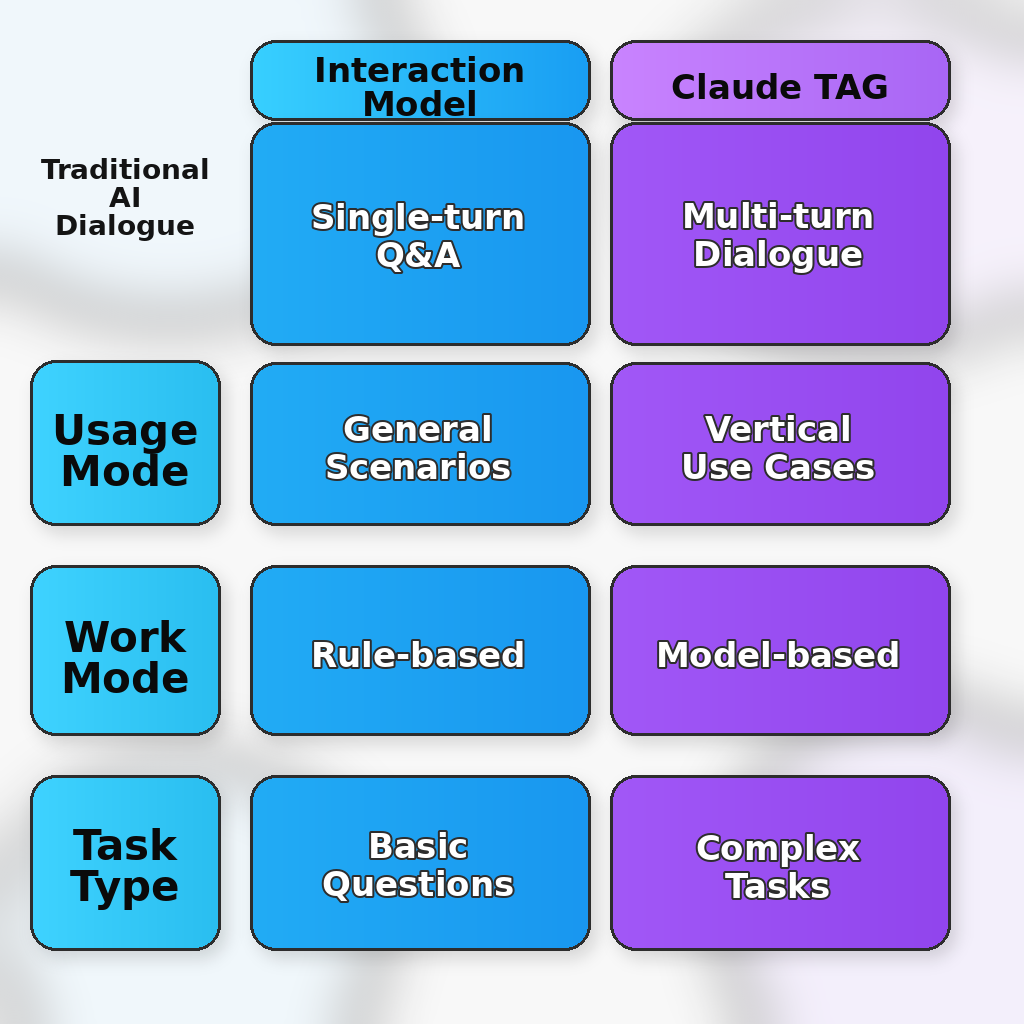
Original article image with English text: the original visual is preserved, and the text is clear and unobstructed
In the first stage, people treated LLMs like websites: open a browser, ask a question, wait for an answer. Later, people treated LLMs like local apps: closer to files and desktops, but still mostly personal.
Claude Tag points to a third form: AI stays inside the team’s existing workflow. It does not need to be summoned from scratch every time, and it does not need the background explained again and again.
This matters because enterprise context is not a single prompt. It is a continuous stream of conversations, tasks, files, email, meetings, and system state. If AI cannot enter that context, it stays stuck at the level of “help me write a paragraph.”
So the value of Claude Tag is not only that it summarizes Slack threads. It lets AI enter context in a way the team can see together.
From pull to push: AI starts entering work proactively
The second shift behind Claude Tag is from pull to push.
In the pull model, humans actively ask AI. The problem is that many important signals do not wait until someone remembers to ask. Customer feedback, task delays, important email, code review changes, and lead movement all happen whether or not someone has opened an AI tool.
In the push model, AI does not only answer questions. Within approved boundaries, it can watch context and alert the team when something important changes.
This is why Claude Tag feels closer to an “AI teammate.” It is not only a passive answer engine. It can participate in the rhythm of work.
How should companies evaluate an AI teammate?
Evaluation point | Question to ask |
Context | Can it inherit full context instead of restarting from zero each time? |
Visibility | Does the output remain inside a team-visible workflow? |
Proactivity | Can it surface important changes within approved boundaries? |
Permissions | Can admins control channels, tools, data, and role access? |
Cost and audit | Is it traceable, budgetable, and auditable? |
Companies should not evaluate Claude Tag-like products only by model power or Slack integration. They should ask whether the product can enter the team workflow safely, persistently, and controllably.
Those questions decide whether an AI agent is a toy feature or real workplace infrastructure.
Claude Tag matters not because Slack gets another @Claude, but because it shows that the real gate for enterprise AI is not only model quality. It is workflow entry, context inheritance, permission control, and organizational habit.
AI that enters daily collaboration can move from “tool” to “teammate.”
Final takeaway: enterprise AI is gated by workflow, not only models
So the future question for companies is not “which AI answers more beautifully?” It is: which AI enters the real process, which system keeps information flowing, and which product can keep working inside a safe operational boundary.
FAQ
What is Claude Tag?
Claude Tag is a Slack-native AI agent experience from Anthropic. Teams can mention @Claude in a Slack thread so it can read context, break down tasks, and surface important updates.
Why is Claude Tag not just a normal Slack bot?
A normal bot usually responds passively. Claude Tag emphasizes shared context, team visibility, ongoing follow-up, and permission control.
Who should pay attention to Claude Tag first?
Teams that deeply use Slack, have Claude Enterprise or Team plans, and need cross-team workflow automation should pay attention first.
What is the biggest shift it introduces?
The biggest shift is not a new chat box. It is AI moving into workflow and changing from one-off Q&A to ongoing collaboration.
What is the most important ability of an enterprise AI teammate?
Not one-off answer quality. The important abilities are presence, memory, proactivity, tool connections, permission isolation, and controllable cost.
Related Tools
• Claude
• Slack
• Gmail
Sources
• Reuters: Anthropic launches Claude Tag in Slack