Claude Fable 5 Is Back, but Safety Fallbacks Are Frustrating Developers
Claude Fable 5 has returned after export-control restrictions were lifted, but developers are reporting frequent safety-classifier false positives, forced fallbacks to Opus 4.8, higher usage costs, and mixed results in Claude Code.

Claude Fable 5 Is Back, but Safety Fallbacks Are Frustrating Developers
Introduction
After being unavailable for nearly three weeks, Claude Fable 5 has returned to Claude.ai, Claude Code, and other Anthropic surfaces. For many developers, that should have been a clean comeback: the strongest coding model is back, long-running agent work can resume, and Claude Code users can once again test the model on ambitious engineering tasks.
But the first wave of user feedback has been messy.
Instead of a smooth return, developers are running into a new problem: safety classifiers are frequently flagging normal coding, debugging, research, and technical prompts. When that happens, requests can be routed away from Fable 5 and sent to Opus 4.8 instead. The result is a strange experience: users select the premium model, but parts of the workflow suddenly fall back to a weaker model.
This article walks through what happened, why developers are upset, what Fable 5 still does extremely well, and why Anthropic is trying to balance frontier capability with increasingly strict safety controls.
Fable 5 Returned After 19 Days Offline
Fable 5 disappeared for about 19 days before coming back to Claude. When it reappeared, developers quickly checked Claude Code and the web interface to see whether the model was available again.
The return was not unlimited. Anthropic’s own announcement says Fable 5 became available globally after export controls on Fable 5 and Mythos 5 were lifted. For Pro, Max, Team, and select Enterprise plans, Fable 5 was included for up to 50% of weekly usage limits through July 7, after which usage credits were required.
That already made the comeback feel limited. Users could access the model, but only within a constrained allowance. Once that allowance was used, Fable 5 could consume additional usage credits faster than Opus 4.8.

For developers who had waited for the model to return, the real frustration started when ordinary coding tasks began triggering safety fallbacks.
Disaster-Level Experience: A Line of Code Can Trigger a Fallback
The biggest complaint is not simply that Fable 5 has usage limits. It is that the new safety system can interrupt normal development work.
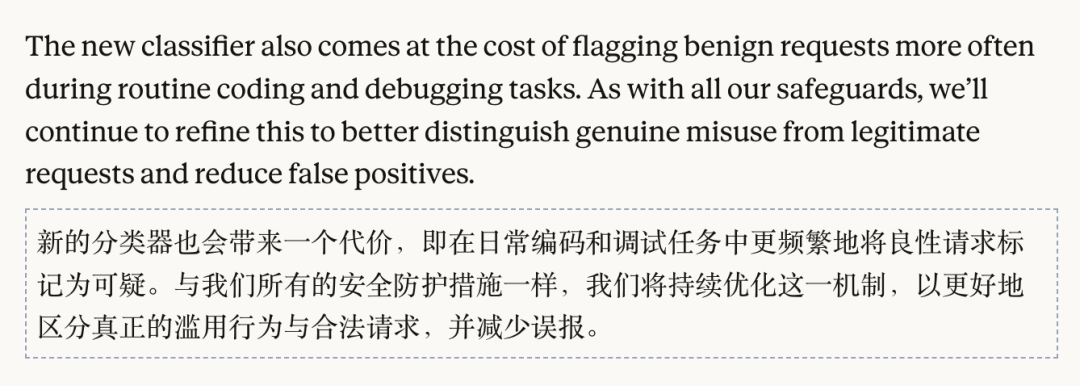
According to Anthropic’s redeployment note, the company trained an improved safety classifier after a reported bypass. If a request to Fable 5 is blocked, the user is notified and the request is sent to Opus 4.8 instead. Anthropic also acknowledged the trade-off: the new classifier can flag benign requests more often during routine coding and debugging.

That is where the developer backlash began. In practice, some users found that Fable 5 would start a coding task, then suddenly route the request to Opus 4.8 after the classifier fired. From the user’s point of view, the model feels like it has been “downgraded” mid-workflow.
The problem is especially painful in Claude Code because the model is often handling multi-file context, debugging loops, tests, logs, and local commands. A false positive does not just block one chat reply. It can break the rhythm of a long development session.
For a model positioned as a high-end coding and long-horizon agent model, that interruption changes the experience dramatically. Users are not only paying for frontier capability. They are also dealing with the uncertainty of whether that capability will stay available for the task in front of them.
Why the New Safety Classifier Exists
Anthropic’s explanation centers on cybersecurity safety. The company says the June restrictions followed a report involving a method that bypassed Fable 5’s safeguards. In that case, the model identified software vulnerabilities and, in one instance, produced code demonstrating how a vulnerability could be exploited.
Anthropic says the updated classifier was trained to target and block that reported behavior. The company also says the specific technique is now blocked in more than 99% of cases, while low-risk defensive cybersecurity capabilities are not meant to be entirely blocked.
So the trade-off is clear:
- Anthropic wants to reduce the chance that Fable 5 can be used for dangerous cybersecurity behavior.
- To do that, the classifier has been made more conservative.
- A more conservative classifier creates more false positives.
- Those false positives are now showing up in normal coding, debugging, and research work.
This is why many developers feel the model has become powerful but constrained. The capability is there, but the safety layer can make it hard to access consistently.
Trees Get Flagged, Drone Swarms Do Not: The Double-Standard Complaint
One Reddit post captured the frustration particularly well. A PhD student in Earth Science said they were working on a project about how trees reduce environmental temperature. When they asked Fable 5 for help refining research methods, the safety classifier repeatedly triggered and switched the task to Opus 4.8.
The same user then tested the system with a clearly unrelated high-risk drone-swarm prompt. According to the post, Fable 5 answered that prompt while continuing to block the ecology-related research workflow.

The point was not that users should try dangerous prompts. The point was that the classifier appeared inconsistent. A beneficial environmental-science workflow was blocked, while a much more obviously sensitive topic seemed to slip through.
That kind of mismatch is what makes safety systems feel arbitrary. Users can accept that powerful AI models need boundaries. What frustrates them is when the boundaries appear to block harmless work while missing riskier prompts.
Without the Guardrails, Fable 5 Still Looks Like a Strong Coding Model
The backlash does not mean Fable 5 is weak. Quite the opposite: many developers still describe it as an unusually strong model when the safety system does not interrupt the task.
Anthropic positions Fable 5 as a model for difficult knowledge work, ambitious coding projects, long-running agent sessions, and multi-stage workflows. Developers who tested it on complex codebases reported that it could work across many files, add logs, test edge cases, verify its own fixes, and continue debugging after failures.

This is where Fable 5’s value is clearest. It is not mainly about producing a short code snippet faster than other models. Its strength is in extended task execution: understanding a messy project, planning a sequence of changes, editing multiple files, running tests, analyzing failures, and trying again.
For teams using Claude Code, that kind of “closed loop” is the entire reason to reach for a stronger model. If it works, Fable 5 can feel less like a chat assistant and more like a senior engineer who can stay inside the problem for a long time.
Closed-Loop Execution Is the Main Selling Point
The strongest positive feedback centers on long-horizon coding and agent tasks.
A typical high-value Fable 5 workflow looks like this:
- Give the model a multi-file refactor or debugging task.
- Let it inspect the codebase and plan the work.
- Have it edit files, add logs, and create or run tests.
- Let it verify whether the change actually worked.
- If the fix fails, let it investigate the failure and try again.
- Preserve learning from the debugging loop and continue.
This is much more demanding than asking a chatbot to write a function. It requires planning, memory, tool use, test discipline, and self-correction.
That is also why forced fallback is so disruptive. If the model is doing a long chain of work and suddenly falls back to Opus 4.8, the workflow can lose consistency. The user may have to re-check assumptions, rerun tests, or manually guide the weaker model back into the task.
A 20-Minute Blender Test Recreated New York City
One widely shared test connected Fable 5 with Blender. In roughly 20 minutes, the model reportedly recreated a New York City cityscape.
What made the example impressive was not only the visual output. The model reportedly began by pulling building data from public sources before constructing the scene. That suggests a more structured approach: gather the data first, then build the asset around real proportions instead of improvising blindly.

This is the kind of task where a stronger agent model can stand out. The model has to coordinate external information, 3D tooling, scale, scene construction, and execution order. It is not just answering a prompt. It is managing a workflow.
A $173 Game Built from Four Prompts
Another example came from AI creator Riley Brown, who reportedly spent $173 in token usage and used only four prompts to have Fable 5 build a complete game called The Race for Super Intelligence from scratch.
The cost is important. Fable 5 can be powerful, but it is not cheap when used heavily. Long-running coding and creative-agent workflows can burn through tokens quickly, especially when the model is exploring, testing, revising, and generating assets or code at length.
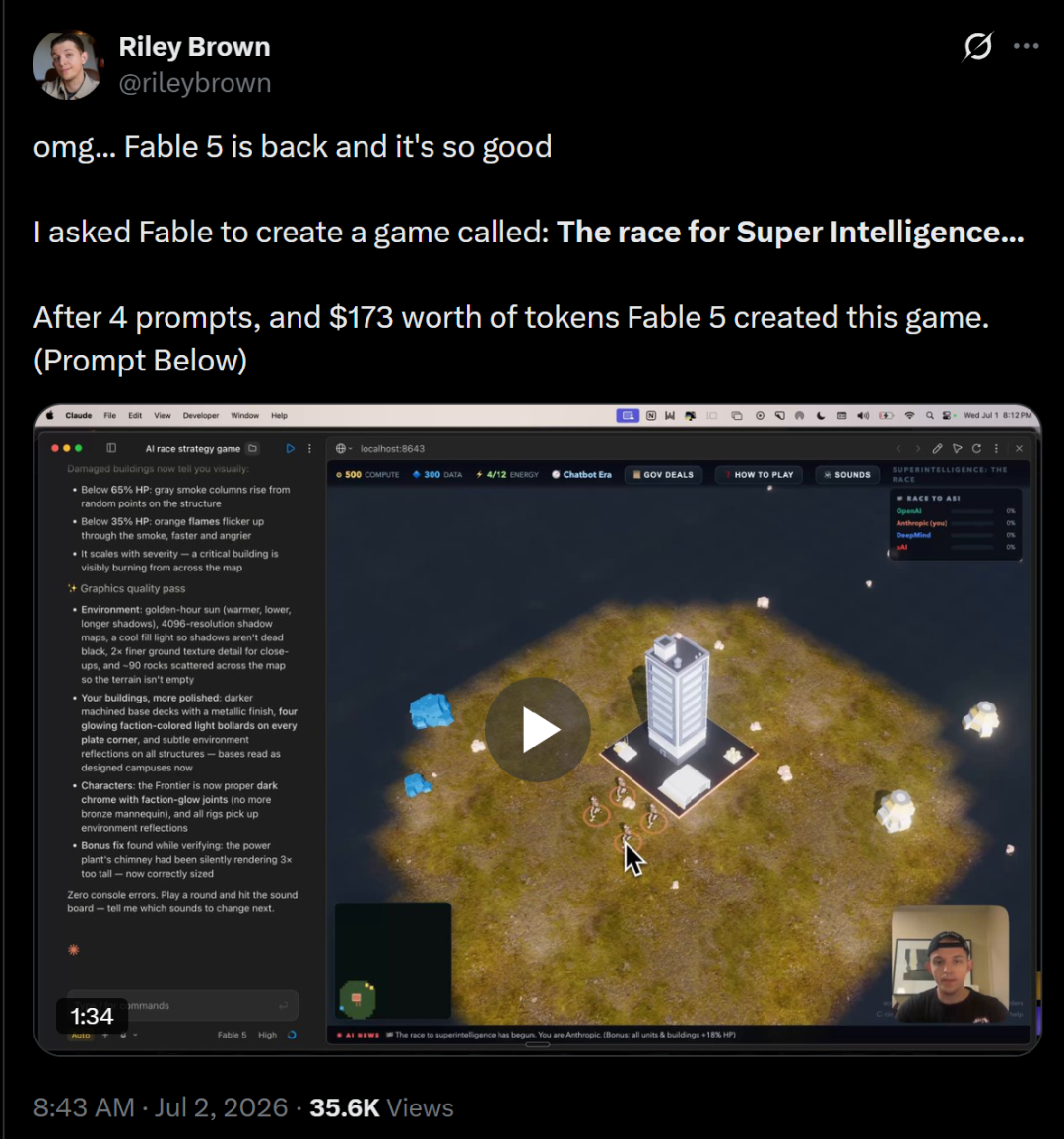
For serious builders, the question becomes practical: is the output worth the token cost? For simple tasks, probably not. For difficult, multi-step builds where the model can save many hours of engineering time, the answer may be yes.
Prompt Recommendation for Power Users
The original article also pointed to a “system architect” style prompt template for users who want to get the most out of Fable 5. The basic idea is sensible: use Fable 5 for complex planning, architecture, multi-file debugging, and agentic implementation—not for casual chat or trivial tasks.

A practical rule is simple: use Fable 5 when the task needs real reasoning depth, long context, or autonomous execution. For lightweight writing, quick Q&A, or small edits, a cheaper model is usually enough.
If Fable 5 does not appear in Claude Code, some community users suggested updating to the latest Claude Code channel. The official Claude Code documentation lists Homebrew as one install option and explains that claude-code@latest tracks the latest release channel.
brew install --cask claude-code@latest
For stable usage, always check the current Claude Code documentation before changing install channels, especially if your workflow depends on predictable updates.
Anthropic’s Other Controversy: Sonnet 5 Pricing and “Laziness” Complaints
The Fable 5 incident also arrived alongside debate around Sonnet 5.
Some users argued that Sonnet 5 looked expensive relative to its performance. Screenshots circulated comparing cost-per-intelligence-index-task numbers across models, with Sonnet 5 appearing far less attractive than cheaper alternatives in certain comparisons.

Cost is only one part of the complaint. Some developers also said Sonnet 5 was more likely to refuse or avoid tasks, making it feel less reliable for hands-on development.
Whether those claims hold across broader usage is hard to judge from scattered user reports. But as a perception problem, the timing was poor. Fable 5 returned with safety friction, while Sonnet 5 was being criticized for value and consistency.
Anthropic’s Late-Night Response
Anthropic’s redeployment post tries to explain the situation from the company’s side. The company says the AI industry does not yet have a shared standard for evaluating the severity of AI jailbreaks. Without a common framework, developers, labs, governments, and partners have no consistent way to decide which findings require immediate action.

Anthropic proposed a four-part framework for assessing jailbreak severity:
- Capability gain: How much more powerful does the jailbreak make the user compared with existing tools?
- Breadth of gain: Does the jailbreak work for one narrow behavior, or does it unlock many offensive tasks?
- Ease of weaponization: How much effort is needed to turn the jailbreak into a real attack?
- Discoverability: Is the technique obscure, or is it already easy to find and reuse?
The company also said it is working with Amazon, Microsoft, Google, and other partners on a shared framework. It also described deeper cooperation with the U.S. government, including pre-release testing, rapid information sharing, dedicated AI security research resources, and a common industry bar.
What This Means for Developers
For developers, the main takeaway is not simply “Fable 5 is good” or “Fable 5 is broken.” The reality is more mixed.
Fable 5 appears to be extremely strong for the tasks it was designed for: deep coding, multi-step architecture, autonomous debugging, agent workflows, and long-running execution. But the new safety layer can make the model feel unpredictable in daily use.
This means developers should treat Fable 5 as a high-end tool for selected workloads, not as a default model for every prompt. It is best used when the task is complex enough to justify the cost and when the user is prepared to supervise fallback behavior.
For production teams, it also reinforces a bigger lesson: do not build an engineering workflow that depends entirely on one frontier model always being available. Keep documentation, prompts, codebase instructions, and fallback models ready.
FAQ
What is Claude Fable 5?
Claude Fable 5 is Anthropic’s high-end model for difficult coding, knowledge work, long-running agent tasks, and complex multi-stage workflows. Anthropic describes it as a model built for ambitious work that previous models could not sustain as easily.
Why does Fable 5 switch to Opus 4.8?
Fable 5 can route requests to Opus 4.8 when Anthropic’s safety classifier blocks a request. This is mainly connected to safeguards around cybersecurity and other sensitive areas, but users have reported false positives during normal coding and debugging.
Is Fable 5 available in Claude Code?
Yes, Anthropic says Fable 5 is available through Claude.ai, Claude Code, Claude Cowork, and the Claude Platform after redeployment. Availability can depend on plan type, usage limits, credits, and current rollout status.
Why are developers angry about Fable 5?
Many developers are frustrated because ordinary technical prompts can trigger safety fallbacks. When that happens during a coding session, the workflow may switch away from Fable 5 and lose the quality or consistency users expected.
Is Fable 5 still good for coding?
Yes, when it is not interrupted by safety filters, many users report that Fable 5 is strong for complex coding, long-running agent tasks, refactoring, testing, and debugging. The problem is not only capability; it is reliability of access during real workflows.
Should I use Fable 5 for simple tasks?
Usually no. Fable 5 is better saved for difficult engineering or knowledge-work tasks where deep reasoning and long execution matter. For casual chat, quick edits, or small coding questions, a cheaper or faster model may be more practical.
Is Fable 5 suitable for production workflows?
It can be useful in production-adjacent development workflows, but teams should not depend on it as the only available model. Because access, safety routing, and usage credits can change, serious teams should keep fallback plans, project documentation, and clear human review steps in place.
Related Tools
- Claude: Anthropic’s AI assistant for writing, research, coding, and workflow support.
- Claude Code: Anthropic’s agentic coding tool for reading codebases, editing files, running commands, and automating development work.
- Claude Platform: Anthropic’s developer platform for building applications with Claude models through API access.
- Anthropic: The AI research company behind Claude, Claude Code, Fable, Opus, Sonnet, and Haiku models.
- HackerOne: Anthropic’s HackerOne program for coordinated vulnerability reporting.
- Blender: An open-source 3D creation suite mentioned in user tests connecting Fable 5 to 3D scene generation.
Related Links
- Original BAAI Article: The Chinese source article that this English version is based on.
- Redeploying Fable 5: Anthropic’s official announcement explaining the redeployment, safeguards, and jailbreak framework.
- Claude Fable 5 Model Page: Official Anthropic page covering Fable 5 availability, pricing, use cases, safeguards, and benchmarks.
- Claude Code Overview: Official documentation for installing and using Claude Code across terminal, IDE, desktop, and web environments.
- NIST Center for AI Standards and Innovation: U.S. government AI standards and evaluation body referenced in Anthropic’s redeployment post.
- FIRST CVSS: The Common Vulnerability Scoring System, referenced by Anthropic as an example of a shared severity-scoring standard in security.
- Reddit User Report: Community report discussing Fable 5 fallback behavior in an environmental-science workflow.
Source Note
This article is based on the original Chinese article published on BAAI Hub and the official Anthropic documentation linked above. The rewritten version preserves the main structure and technical meaning but uses fresh English wording for readability and publication.
The original article contained several decorative logos, publisher marks, and promotional images. Those were not included in the article body. Relevant screenshots, interface captures, user reports, and comparison images were retained where they directly support the article.
Some original image links were slow or timed out during preview. In those cases, the captured image URL was kept only when the image position was clearly tied to the article’s meaning, and no unreadable image content was transcribed or invented.
Summary
Fable 5 is back, but its return is complicated. Anthropic restored access after the export-control disruption, yet the stricter safety classifier is creating visible friction for developers using Claude Code and other coding workflows.
The model still appears powerful for long-horizon engineering, multi-file debugging, agent tasks, and complex creative builds. The issue is that false positives and forced fallbacks can make the experience feel inconsistent, especially when users are paying for a high-end model.
For now, Fable 5 is best treated as a premium model for serious tasks, not a default model for every interaction. Its core capability is impressive, but its practical value depends on whether Anthropic can reduce false positives without weakening the safety layer.