Claude Fable 5 Is Back, But GLM-5.2 Looks Like the Better Value
Claude Fable 5 has returned after a temporary access pause, but its new usage limits, safety fallbacks, and high API pricing make GLM-5.2 a serious cost-effective alternative for coding, agent workflows, and long-context tasks.

Claude Fable 5 Is Back: Access Limits, Pricing, Benchmarks, and Why GLM-5.2 Looks So Cost-Effective
Introduction
Claude Fable 5 is back online, and the AI community has started testing it again almost immediately. The model’s return matters because Fable 5 was widely seen as one of the strongest options for complex coding, long-running agent tasks, visual generation workflows, and high-effort professional work.
But the comeback is not as simple as “everything is back to normal.” Access is limited, usage may become more expensive, and Anthropic has added stricter safety safeguards that can route some requests away from Fable 5. At the same time, GLM-5.2 has become a serious alternative for teams that care about cost, coding ability, and long-context agent workflows.
This article walks through what changed, what the pricing looks like, how Fable 5 compares with other models, and why GLM-5.2 is getting so much attention as a practical value pick.
Source Note
This is an original English adaptation based on the public source article from BAAI Hub and the official pages linked at the end of this file. The original page attributes the article to QbitAI and notes that it was sourced from WeChat. Promotional group images, QR-style images, and unrelated community call-to-action graphics from the source page were intentionally omitted.
Original source: BAAI Hub article
Claude Fable 5 Is Back Online
After being unavailable for about nineteen days, Claude Fable 5 has returned to global access. The model is again available across Claude.ai, Claude Platform, Claude Code, and Claude Cowork, according to Anthropic’s redeployment notice.
For users who depend on Claude for coding or professional workflows, this is obviously good news. Many people had been waiting to test Fable 5 again, especially because the model had built a reputation for strong performance in complex multi-step work.

However, the return comes with limits. Pro, Max, Team, and some Enterprise users can access Fable 5 within a restricted weekly allowance for a short promotional window. After that period, Fable 5 moves toward usage-credit-based access rather than being freely available as part of ordinary weekly usage.
The key point is simple: Fable 5 is back, but it is no longer something users should treat as an unlimited daily driver.
Access Window and Usage Limits
Anthropic’s official redeployment page says Fable 5 is included for up to 50% of weekly usage limits for eligible paid users through July 7, 2026. After that, users need usage credits to continue using it.
That makes timing important. If you want to test Fable 5 on real workloads, the best approach is not to waste requests on simple chat. Use it on tasks that actually reveal whether the model is worth the cost:
- Large codebase refactoring
- Complex bug diagnosis
- Long-context document or repository analysis
- Multi-step agent workflows
- Design-heavy front-end generation
- Research synthesis with many files or sources
- End-to-end task execution where mistakes are expensive
Routine prompts, simple writing, or lightweight Q&A are not the best use cases for Fable 5. Those can usually be handled by cheaper models.
Fable 5 Is Powerful, But It Is Expensive
The most obvious tradeoff is price. Claude Fable 5 is positioned as a premium model, and its API pricing reflects that.

Based on official pricing pages, the rough comparison looks like this:
| Model | Input Price | Output Price | Notes |
|---|---|---|---|
| Claude Fable 5 | $10 / 1M tokens | $50 / 1M tokens | Premium Claude model for hard coding and professional work |
| Claude Opus 4.8 | $5 / 1M tokens | $25 / 1M tokens | About half the standard token price of Fable 5 |
| GLM-5.2 | $1.40 / 1M tokens | $4.40 / 1M tokens | Much cheaper listed API pricing from Z.AI |
The original discussion also highlights a more practical issue: total task cost is not only about the rate card. A model that reasons longer, generates more tokens, retries more often, or triggers more fallback behavior can become much more expensive in real use.

In one developer-shared benchmark screenshot, Sonnet 5 reportedly cost more than Fable 5 to run the full test. That does not mean Fable 5 is “cheap.” It means token usage patterns matter. A model with lower per-token pricing can still become expensive if it needs more attempts or produces a lot more output.
So the better question is not “Which model is cheapest per token?” The better question is: Which model completes the job at the lowest total cost with acceptable quality?
Fable 5 Still Looks Strong in Creative and Coding Tests
The early tests shared by developers suggest that Fable 5 remains very strong in creative coding, visual generation pipelines, and physics-style demos. In several HTML5 physics scenes, Fable 5 reportedly produced more natural collision behavior, object falling, and breaking effects than competing models.
The source article also notes visual comparisons where Fable 5 produced cleaner edges and fewer visible defects than some alternatives. These are exactly the kinds of tasks where top-tier models often stand out: not just producing code, but producing code that feels more complete, polished, and physically plausible.
That said, the cost difference matters. In the cited tests, Fable 5’s cost was much higher than GLM-5.2. For teams building prototypes, coding agents, or content workflows at scale, GLM-5.2 may be easier to justify even if Fable 5 wins on some quality details.
Developers Are Using Fable 5 for Bigger Experiments
Beyond direct model comparisons, developers have already started using Fable 5 in more playful and ambitious workflows. Some examples mentioned in the source include using Fable 5 together with Blender to recreate a city-scale scene, and building game-like projects with a surprisingly small amount of code.

These examples are interesting because they show where frontier models are moving. The value is no longer just “answer this question.” It is closer to:
- Plan a project
- Generate assets or code
- Keep context across steps
- Debug the output
- Improve the result
- Deliver something that looks usable
That is why Fable 5 attracts attention even when it is expensive. If a model can reliably finish work that would otherwise take hours or days, the price can still make sense for selected tasks.
Remote Work Automation: Fable 5 Leads, But the Ceiling Is Still Low
One of the stronger benchmark signals comes from the Remote Labor Index, a benchmark designed to measure how well AI agents can complete real remote-work projects end to end.
The source article cites Fable 5 at 16.10% full automation on RLI-style remote projects, ahead of other listed models such as Opus 4.8 and GPT-5.5.
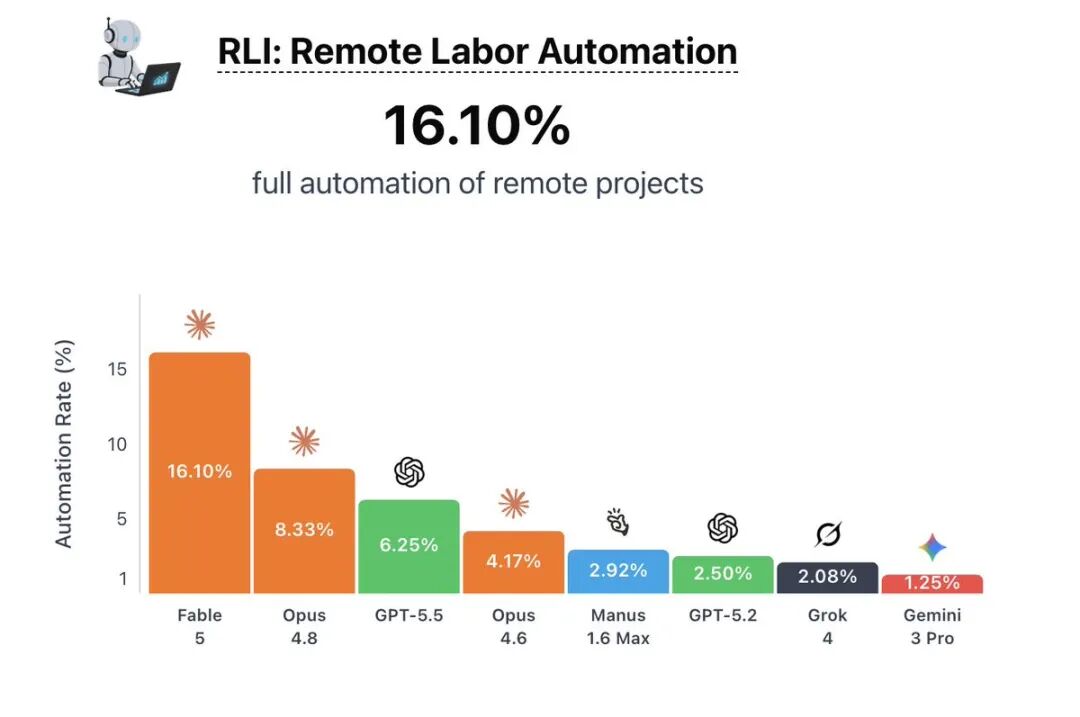
This is a strong result in relative terms. But the absolute number is also a reminder: even the leading model does not fully automate most real-world work yet. AI agents are improving quickly, but many professional tasks still require human judgment, review, context, and final approval.
For practical users, the takeaway is balanced:
- Fable 5 is clearly useful for harder work.
- It can reduce manual effort in complex tasks.
- It should still be reviewed carefully before production use.
- Benchmarks are helpful, but your own workload is the real test.
Why GLM-5.2 Looks More Attractive Now
The original article’s headline points to a key tension: Fable 5 is powerful, but GLM-5.2 may be more attractive for many users because of price.
According to Z.AI’s documentation, GLM-5.2 is designed for long-horizon tasks and project-scale engineering contexts. It supports a large context window and is positioned for coding, agentic workflows, and multi-step software development.
That puts it in the same conversation as Claude’s strongest coding models, even if the experience is not identical.
The main reason people are paying attention is not only capability. It is capability per dollar. If GLM-5.2 can complete a large share of coding and agent tasks at a much lower cost, it becomes a serious option for:
- Startups watching API spend
- Coding-agent builders
- AI development tools
- Open-source workflows
- Long-context repository analysis
- Internal automation projects
- High-volume generation pipelines
This does not mean GLM-5.2 replaces Fable 5 in every case. But it does mean teams should test both instead of assuming the most expensive model is always the best choice.
Fable 5 Is Not Exactly the Same Fable 5
The most important change after Fable 5’s return is not only pricing. It is the stricter safety layer.
Anthropic says the redeployed Fable 5 includes an improved cybersecurity safety classifier. When a request is flagged, users are notified and the request is routed to Claude Opus 4.8 instead of being handled by Fable 5.

This approach is meant to reduce risky behavior, especially around cybersecurity misuse. But it also introduces false positives. In plain English: some normal coding, debugging, or technical requests may be treated as risky even when the user is doing legitimate work.
That is why the returned version may feel different in practice. The underlying model may still be highly capable, but the path between your prompt and the model is now more constrained.
BridgeBench Shows the Side Effect of Stricter Safeguards
The source article also references BridgeBench-style debugging results where the July 1 version of Fable 5 dropped sharply in debugging ranking. The issue was not necessarily that the model became less intelligent. The issue is that the stricter classifier can stop requests from reaching Fable 5 in the first place.

For developers, this matters a lot. If a coding assistant silently or frequently falls back to a different model, the final experience may not match the benchmark reputation of the original model.
This is especially important for:
- Security tooling
- Debugging workflows
- Automated refactoring
- CI/CD agents
- Code repair benchmarks
- Production coding assistants
If you use Fable 5 in serious engineering work, you should test whether your normal prompts trigger fallback behavior. If they do, you may need to adjust prompts, split tasks, or use another model for certain workflows.
Practical Model Selection Advice
The safest way to evaluate Fable 5, Opus 4.8, Sonnet 5, and GLM-5.2 is to run your own workload benchmark.
A simple test plan can look like this:
- Pick 10 to 20 real tasks from your own workflow.
- Include easy, medium, and hard tasks.
- Track total input tokens, output tokens, retries, and failed attempts.
- Measure whether the final result is actually usable.
- Record whether the model triggers refusal or fallback behavior.
- Compare total task cost, not only per-token price.
- Keep human review in the loop for production changes.
For now, Fable 5 looks best suited for the hardest tasks where quality matters more than cost. GLM-5.2 looks especially attractive when volume, budget, or open-model flexibility matters more.
FAQ
What is Claude Fable 5?
Claude Fable 5 is a premium Claude model from Anthropic designed for difficult coding, long-running agent tasks, and advanced professional workflows. It is positioned above routine chat models and is intended for complex work where stronger reasoning and execution quality matter.
Why did Claude Fable 5 become unavailable?
Anthropic temporarily suspended access after export-control-related issues and cybersecurity concerns around model safeguards. Access was later restored after Anthropic introduced updated safety measures and coordinated with relevant government reviewers.
Is Claude Fable 5 free for Pro, Max, or Team users?
Not exactly. Eligible paid users received limited promotional access within weekly usage limits through a short window. After that, continued use depends on usage credits or the access rules Anthropic applies at the time.
Is Claude Fable 5 more expensive than Claude Opus 4.8?
Yes. Official API pricing lists Fable 5 at a higher per-token rate than Opus 4.8. The total cost gap can be even larger or smaller depending on the task, because reasoning length, retries, output volume, and fallback behavior all affect real usage cost.
Why is GLM-5.2 being compared with Claude Fable 5?
GLM-5.2 is being discussed because it targets long-context coding and agentic workflows while offering much lower listed API pricing. It may not beat Fable 5 in every high-end task, but it can be very attractive for teams that need strong capability at a lower cost.
Does the new Fable 5 safety classifier affect coding work?
It can. Anthropic says the updated classifier may flag a higher share of harmless requests than before, especially around coding and debugging. When that happens, the request may be routed to Opus 4.8 rather than handled directly by Fable 5.
Should developers use Fable 5 in production workflows?
Fable 5 can be useful for demanding engineering tasks, but it should be tested carefully before production use. Developers should monitor cost, output quality, fallback behavior, and safety-related interruptions instead of relying only on public benchmark results.
Related Tools
- Claude.ai: Anthropic’s main Claude web interface for chat, writing, analysis, and model access.
- Claude Fable: Official Anthropic page for Claude Fable model availability, use cases, and pricing notes.
- Claude Code: Anthropic’s agentic coding tool for reading codebases, editing files, running commands, and automating development work.
- Claude Cowork: Anthropic’s agentic workspace product for multi-step knowledge work on local files and tasks.
- Claude Platform: The developer platform for building applications with Claude models through the API.
- Z.AI GLM-5.2: Official documentation for GLM-5.2, Z.AI’s long-horizon flagship model.
- Remote Labor Index: A benchmark focused on AI automation of real remote-work projects.
- BridgeBench: A benchmark site for comparing AI coding, debugging, refactoring, and agentic coding performance.
Related Links
- Anthropic: Redeploying Fable 5: Official redeployment note covering access restoration, timeline, and safeguard updates.
- Claude Fable Official Page: Official product page for Fable 5 availability, pricing, and use cases.
- Claude Platform Pricing: Official pricing page for Claude API token costs, prompt caching, batch pricing, and long-context pricing.
- Claude Code Documentation: Official documentation for installing and using Claude Code across terminal, IDE, desktop, and browser environments.
- Claude Cowork Product Page: Official product page describing Claude Cowork for multi-step knowledge work.
- Z.AI GLM-5.2 Overview: Official GLM-5.2 documentation covering positioning and long-horizon engineering use cases.
- Z.AI Pricing: Official Z.AI pricing page for GLM-5.2 and other Z.AI models.
- Remote Labor Index: Official benchmark page for evaluating AI agents on real-world remote labor projects.
Summary
Claude Fable 5 is back, and it remains one of the most interesting models for hard coding, agentic work, creative generation, and long-context professional tasks. But the return comes with tighter usage limits, usage-credit-based access, and stricter safety safeguards that can affect real developer workflows.
The biggest practical lesson is that model choice should be based on total task performance, not hype. Fable 5 may be the stronger option for difficult, high-value work, while GLM-5.2 is increasingly compelling when cost, scale, and long-context coding matter.
For teams building AI products, coding agents, or automation systems, the best next step is to test both models on real tasks and compare quality, failure rate, fallback behavior, and total cost.
Fable 5 is powerful, but GLM-5.2 may be the smarter default when value matters.