Best AI Website Builders for AI Search Visibility in 2026: Wix, Framer, Webflow, We0 Compared
In 2026, choosing an AI website builder is no longer just about generating pages faster. It is about whether your website can be understood, cited, and recommended by Google, AI Overviews, ChatGPT-style search, and other AI discovery channels. This guide compares Wix, Framer, Webflow, and We0.
If you are still choosing an AI website builder in 2026 by asking, “Which one creates pages fastest?”, you are probably asking the wrong question.
Making a website is no longer the hard part.
Type a prompt. Generate a homepage. Change the hero section. Swap the colors. Publish a decent-looking page. Most tools can do that now.
The harder question is this:
After your website goes live, can it be found, understood, cited, and trusted by search engines and AI answer systems?
That is where the real difference starts.
So this is not another shallow comparison of templates, animations, or pricing tables. Let’s look at Wix, Framer, Webflow, and We0 from a more practical angle:
If your goal is AI search visibility — across Google AI Overviews, ChatGPT-style search, Perplexity, AI answers, and traditional Google search — which AI website builder should you choose?
Here is the short version.
Wix is best for teams that want a simple, fast, low-friction way to get online.
Framer is best for people who care deeply about visual polish, portfolios, brand storytelling, and high-quality landing pages.
Webflow is best for teams that have design, marketing, and content resources, and need a powerful CMS and flexible site structure.
We0 is best for owners, indie hackers, consultants, agencies, creators, and export teams who do not just want a website, but want a showcase website that can grow through SEO, GEO, content, analytics, and leads.
In other words, in 2026 you are not just choosing a page builder.
You are choosing the starting point of your acquisition system.
What AI Search Visibility Really Means
Traditional SEO used to focus mostly on rankings, indexation, and clicks.
That still matters. But it is no longer the whole picture.
A user may not search Google, click ten blue links, and compare pages manually. They may simply ask:
“Which AI website builder is best for a SaaS landing page?”
“What website builder is good for SEO and AI search?”
“Compare Webflow and Framer for startup websites.”
“Which tool can help me build a website and get leads?”
Then an AI system gives them a summarized answer.
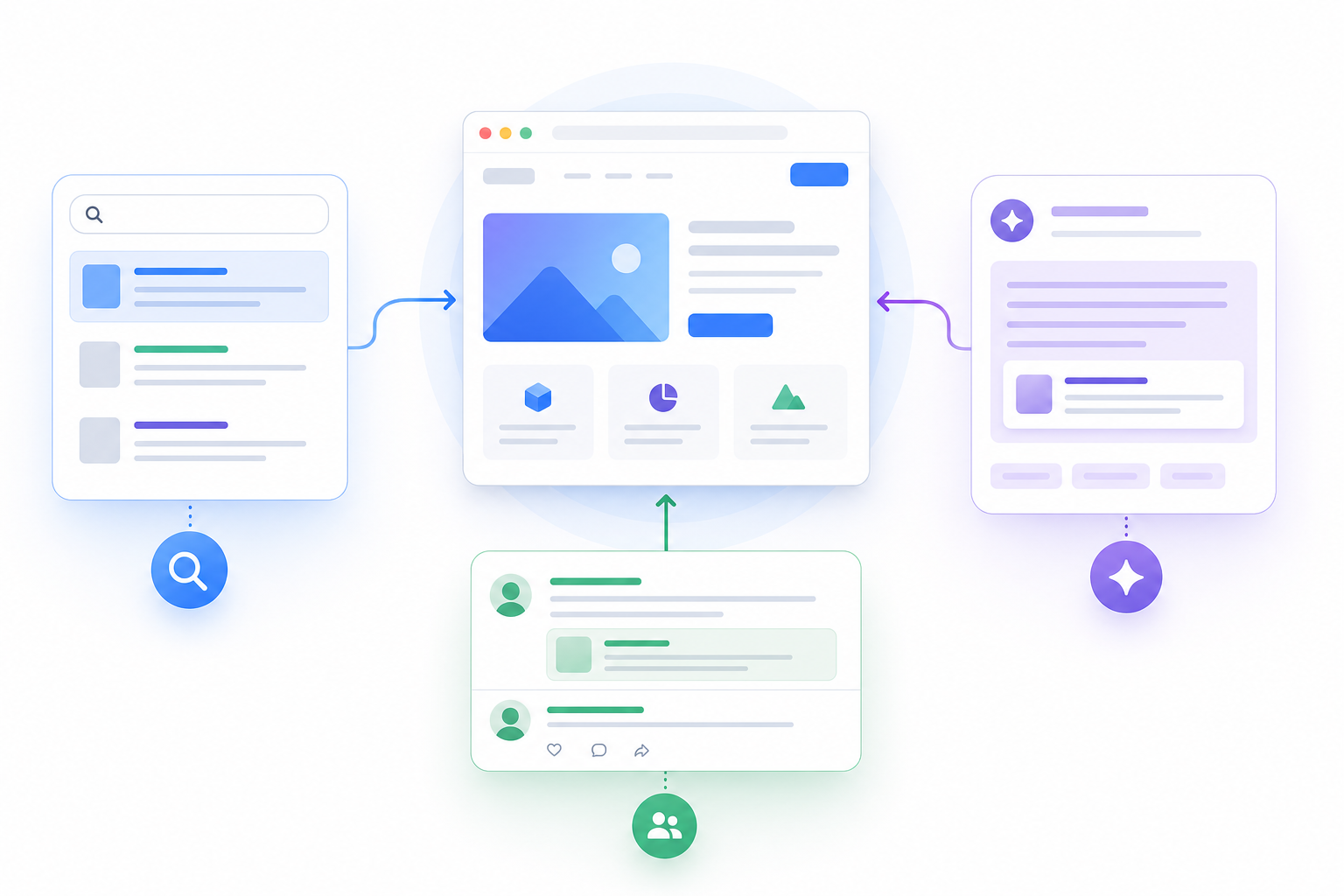
That means your website does not only need to rank. It needs to be machine-readable, source-worthy, and easy to summarize.
AI Search Visibility = technical SEO + structured content + brand entity signals + trustworthy references + continuous updates + clear conversion paths.
Put more simply, your website needs to answer a few questions clearly:
Is the site structure easy to understand?
Does the page answer real search questions?
Are product, service, case study, FAQ, pricing, and comparison information complete enough?
Can search engines and AI systems understand who you are, what you do, and who you are for?
Is the content maintained over time?
Can visitors become leads once they arrive?
A beautiful page gets attention. AI visibility comes from structure, evidence, content, and growth.
That is why many websites look good but still stay invisible.
The design is not the only issue.
The website was never built as a growth asset.
The 5 Things to Check Before Choosing an AI Website Builder
If you are only building a one-off campaign page, speed and visual quality may be enough.
But if you are building a brand site, SaaS site, service website, export business site, consultant site, portfolio, product launch page, or waitlist page, you need to look deeper.
Dimension | Why it matters | Question to ask |
Build speed | Determines how fast you can launch and test | Can I go live in days, not months? |
Showcase quality | Determines whether users understand you | Is my product, service, or case clear? |
SEO foundation | Determines search indexation and ranking potential | Are titles, descriptions, structure, and performance handled? |
GEO / AI visibility | Determines whether AI systems can understand and cite you | Is the content structured, credible, and easy to summarize? |
Growth and leads | Determines whether the site becomes a business asset | Do I have CTAs, forms, analytics, reviews, and optimization loops? |
Most AI website builders stop at the first three.
Many tools help you build and showcase.
But grow and leads? That is usually your problem.
This is where We0 is different.
We0 is built around the full path:
Build -> Showcase -> Grow -> Leads
Build the site. Showcase the business. Grow through SEO, GEO, content, data, and optimization. Then turn attention into leads.
That is the path AI-ready websites need in 2026.

Wix: Great for Fast Launches, Not a Growth Partner by Default
Wix is easy to understand: low barrier, broad feature set, fast setup.
If you are a small business, local service provider, solo operator, or simple project owner, Wix is still a solid choice.
Wix has also been moving seriously into AI, SEO, and AI visibility. Its AI website builder, SEO tools, and AI visibility-related features show that Wix understands where search is going.
Websites are no longer only read by people. They are also read by search engines and AI systems.
But Wix is still mainly a self-serve platform.
It can give you tools. You still need to do a lot of the growth work yourself:
choose keywords
write content
plan site structure
update pages
analyze data
improve conversion paths
If you have time, SEO knowledge, and content skills, Wix can work well.
But many founders, consultants, export business owners, and indie builders are not really missing an editor.
They are missing clarity, structure, content, and ongoing execution.
So Wix is a good fit if you want:
a quick basic website
simple self-management
a low-friction platform
a local business or small company site
It is less ideal if you need:
deeper brand positioning
a stronger B2B or SaaS content strategy
long-term SEO / GEO growth without doing everything yourself
One-line take:
Wix is a useful website platform. It is not automatically your growth team.
Framer: Beautiful, Fast, But AI Search Needs More Than Visual Polish
Framer is popular for a reason.
It creates polished websites, smooth interactions, and high-quality landing pages quickly. For designers, creators, personal brands, and AI product launches, Framer is attractive.
Its AI capabilities are also expanding: page generation, layout help, CMS assistance, SEO review, translation, and publishing are all moving in the right direction.
If your goal is a sharp, premium-looking product page, Framer can get you there fast.
But here is the catch:
AI search will not recommend your website just because it looks expensive.
AI systems care about different signals:
Who are you?
What problem do you solve?
What proof do you have?
Does your page answer real questions?
Is the content structured?
Are there case studies, FAQs, comparisons, references, and updates?
Framer is excellent at the presentation layer.
But AI search visibility requires a content and growth layer too.
A SaaS website, for example, needs more than a beautiful homepage. It often needs:
feature pages
use case pages
industry pages
comparison pages
case studies
pricing
FAQ
blog or resource center
changelog or updates
clear CTAs
Framer can support many of these things, but you still need to bring the content strategy.
Framer is best for:
designers and creators
portfolios
polished startup landing pages
visual product storytelling
teams with someone handling content and SEO
It is less ideal for:
teams with no one maintaining content
companies expecting AI search growth to happen automatically
large structured content programs without operational resources
One-line take:
Framer makes you look professional. Being found by AI search still requires a content and growth system.
Webflow: Powerful and Flexible, But You Need the Team to Use It Well
Webflow has never been just a simple website builder.
It is closer to a visual development platform: flexible design, strong CMS, team collaboration, and the ability to build more complex marketing websites.
By 2026, Webflow is also clearly moving toward AI, AEO, and AI search. Its positioning is no longer only about building websites, but also designing, building, optimizing, and ranking in AI search.
For mature marketing teams, SaaS companies, and brand teams, that is compelling.
Webflow is strong because it offers:
flexible site structure
mature CMS capabilities
content hubs and resource centers
stronger SEO control
integrations with marketing and analytics systems
better design-to-build workflows
If you have a capable team, Webflow can be one of the strongest production systems in this comparison.
But here is the honest part:
Webflow is powerful, but not everyone can make it powerful.
You need information architecture, design skills, CMS planning, SEO knowledge, and ongoing content operations.
Without those, Webflow can become a powerful tool that sits underused.
Webflow is best for:
mature SaaS teams
marketing teams with designers and content people
websites with CMS, case libraries, and resource centers
companies with budget for long-term website operations
It is less ideal for:
people who need to launch quickly without website knowledge
small teams with no content operations
owners who mainly need to clarify the business and start getting leads
One-line take:
Webflow is a strong machine. You still need someone who knows how to drive it.
We0: Not Just Page Generation, But Showcase Website Growth
Now, We0.
If you treat We0 as just another AI website builder, you miss the point.
A more accurate way to describe We0 is:
an AI website-building and growth platform for showcase websites.
It is not only trying to answer, “Can you generate a web page?”
That question is too small now.
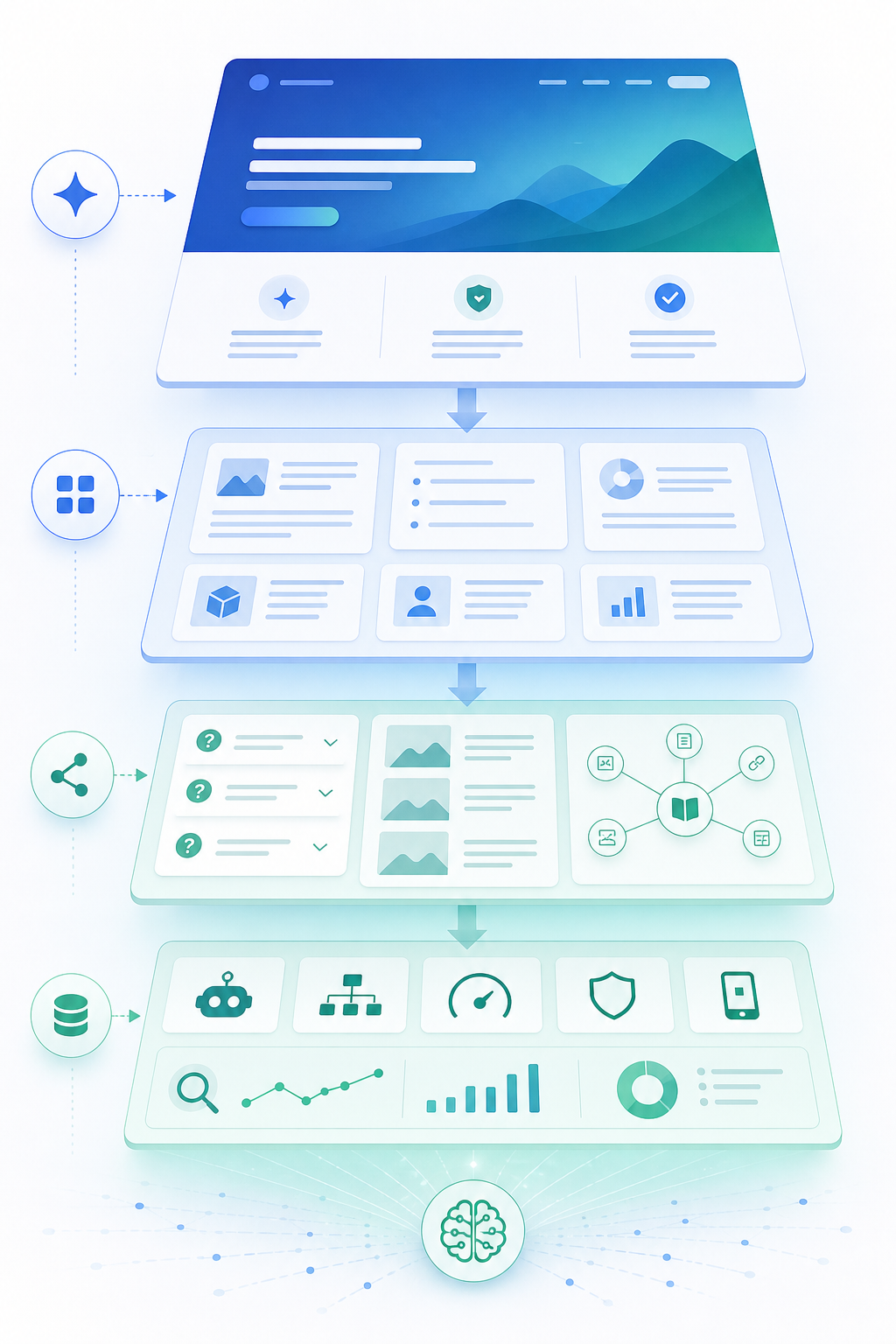
We0 focuses on the bigger chain:
How should your brand information be clarified?
How should the website structure be planned?
How should homepage, service pages, case pages, portfolio pages, and content pages work together?
How should SEO / GEO basics be set up after launch?
How should content be produced and published over time?
How should traffic data be monitored?
Which pages need optimization?
How does traffic become consultations, inquiries, registrations, bookings, or leads?
In other words, We0 is not only about Build.
It is built around:
Build -> Showcase -> Grow -> Leads
That matters a lot in 2026.
Because in the AI search era, your website is not only an online brochure.
It is the source of truth that search engines, AI answer systems, social mentions, and customers use to understand your business.
If that source is thin, AI systems struggle to understand you.
If it is messy, users do not trust you.
If it is never updated, you lose visibility over time.
We0 is especially relevant for:
owners with a real business but unclear website messaging
indie hackers who need a launchable and iterable product site
SaaS and AI product teams building homepages, feature pages, pricing pages, and case pages
agencies and consultants building service and case-study sites
export companies building multilingual product and inquiry websites
creators, experts, and freelancers building personal brand sites
local service providers building service, review, and booking pages
We0’s strength is not just that AI helps build the site.
The more important part is how it connects website building with growth work:
brand and website structure planning
page and copy planning
website setup and optimization
launch support
SEO / GEO fundamentals
traffic data monitoring
content production and publishing
internal and external content distribution
growth suggestions and monthly reviews
continuous optimization and growth execution
This feels less like a traditional software tool.
It feels more like:
an AI website platform plus a showcase-site growth team.
That is why We0 has a distinct position in an AI search visibility comparison.
It is not trying to win by having the most buttons.
It is trying to answer a better question:
Can this showcase website become searchable, understandable, recommendable, and conversion-ready from day one?

Wix vs Framer vs Webflow vs We0: Which One Should You Choose?
Tool | What it feels like | Best for | AI search visibility risk | Recommendation |
Wix | Low-barrier self-serve website platform | Small businesses, local services, personal projects | Can stop at basic SEO; content and growth are on you | Choose Wix if you want fast, simple, and good enough |
Framer | High-polish design-first website builder | Designers, creators, polished landing pages | Strong visual layer, but content system may be thin | Choose Framer if premium visual expression matters most |
Webflow | Professional visual development and CMS platform | SaaS, brand teams, marketing teams | Powerful, but needs a team to operate well | Choose Webflow if you have the team and system |
We0 | AI website building plus showcase-site growth platform | Owners, indie hackers, consultants, agencies, export teams | More focused on showcase growth, not complex web apps | Choose We0 if you want the site to keep growing and generating leads |
Simple version:
Need a basic site fast? Choose Wix.
Need a beautiful landing page? Choose Framer.
Have a team and need a complex content system? Choose Webflow.
Want a website that can showcase, grow, and generate leads over time? Choose We0.
No tool is universally best.
But the wrong tool creates a specific problem:
You may end up using a page tool to solve a growth problem.
A Practical Decision Framework
Ask yourself these questions.
1. Do you have someone to keep producing content?
If yes, Webflow or Framer can work well.
If not, you need a platform or service that thinks about content, SEO / GEO, and optimization together.
That is where We0 becomes more relevant.
AI search visibility is not a one-time setting. It comes from continuous content, structured messaging, proof, and updates.
2. Is your site a showcase website or a product application?
If you are building a complex web app, none of these website builders is the full answer.
But if you are building a:
brand website
product website
service page
case-study page
portfolio
resource center
lead generation page
launch page
waitlist page
Then We0 is a strong fit.
Because these pages are not about complex functionality.
They are about:
clarity, discoverability, trust, and leads.
3. Are you missing a tool, or are you missing growth execution?
This is the big one.
Many people think they need a better builder.
Often, they actually need:
clearer positioning
better homepage copy
better site structure
SEO keyword planning
AI-search-friendly content
monthly optimization work
If you mainly need a tool, Wix, Framer, and Webflow are all good options.
If you need the execution path from website to growth, We0 is closer to the real problem.
FAQ
What is the best AI website builder for AI search visibility in 2026?
There is no single best option for everyone. Wix is best for fast basic websites, Framer for polished visual pages, Webflow for teams with CMS and marketing operations, and We0 for showcase websites that need SEO, GEO, content, optimization, and lead generation.
Is AI search visibility the same as SEO?
Not exactly. SEO focuses on search ranking and clicks. AI search visibility focuses on whether AI systems can understand, summarize, cite, and recommend your website. The two are connected: strong AI visibility usually starts with strong SEO fundamentals.
Is We0 only an AI website builder?
No. We0 is better understood as an AI website-building and growth platform for showcase websites. It combines website building, brand structure, page planning, SEO / GEO basics, content production, analytics, and ongoing optimization.
Which tool is best for SaaS websites?
For a mature SaaS team with designers and content operations, Webflow can be very strong. For a SaaS or AI product team that needs to launch, clarify messaging, build pages, and connect the site to growth and leads, We0 can be a strong fit.
Does a beautiful website help AI search visibility?
It helps users trust you, but it is not enough. AI search visibility depends more on structured content, clear positioning, useful answers, credible proof, technical SEO, references, and ongoing updates.
Related Tools
Sources
Conclusion
The AI website builder market has changed.
It used to be about who could generate faster, offer more templates, or create prettier animations.
Now the real question is:
Who can help your website become a visible, trusted, and conversion-ready business asset over time?
Wix, Framer, and Webflow all have clear strengths.
But if your question is not “How do I make a website?” and is really “How do I make my website keep bringing customers?”, We0 is closer to the actual need.
The future website is not only about Build.
It also needs to Showcase, Grow, and generate Leads.