AI Search Is Changing SEO: How Google AI Overviews, ChatGPT Search, and Perplexity Decide What to Cite
AI search is changing SEO because discovery is moving from ranked blue links to generated answers with source citations. This article explains how Google AI Overviews, ChatGPT Search, and Perplexity use citations, why source selection matters for websites and brands, and what content teams should do to become more citation-worthy. It covers semantic relevance, authority, freshness, structured content, evidence, claim support, and conversion paths for brands that want visibility in both traditional search and AI answer engines.
AI Search Is Changing SEO: How Google AI Overviews, ChatGPT Search, and Perplexity Decide What to Cite
For years, SEO had a fairly clear goal: get a page indexed, make it relevant to a query, earn authority, rank high enough to be seen, and win the click. That model still matters. But it is no longer the only discovery path.
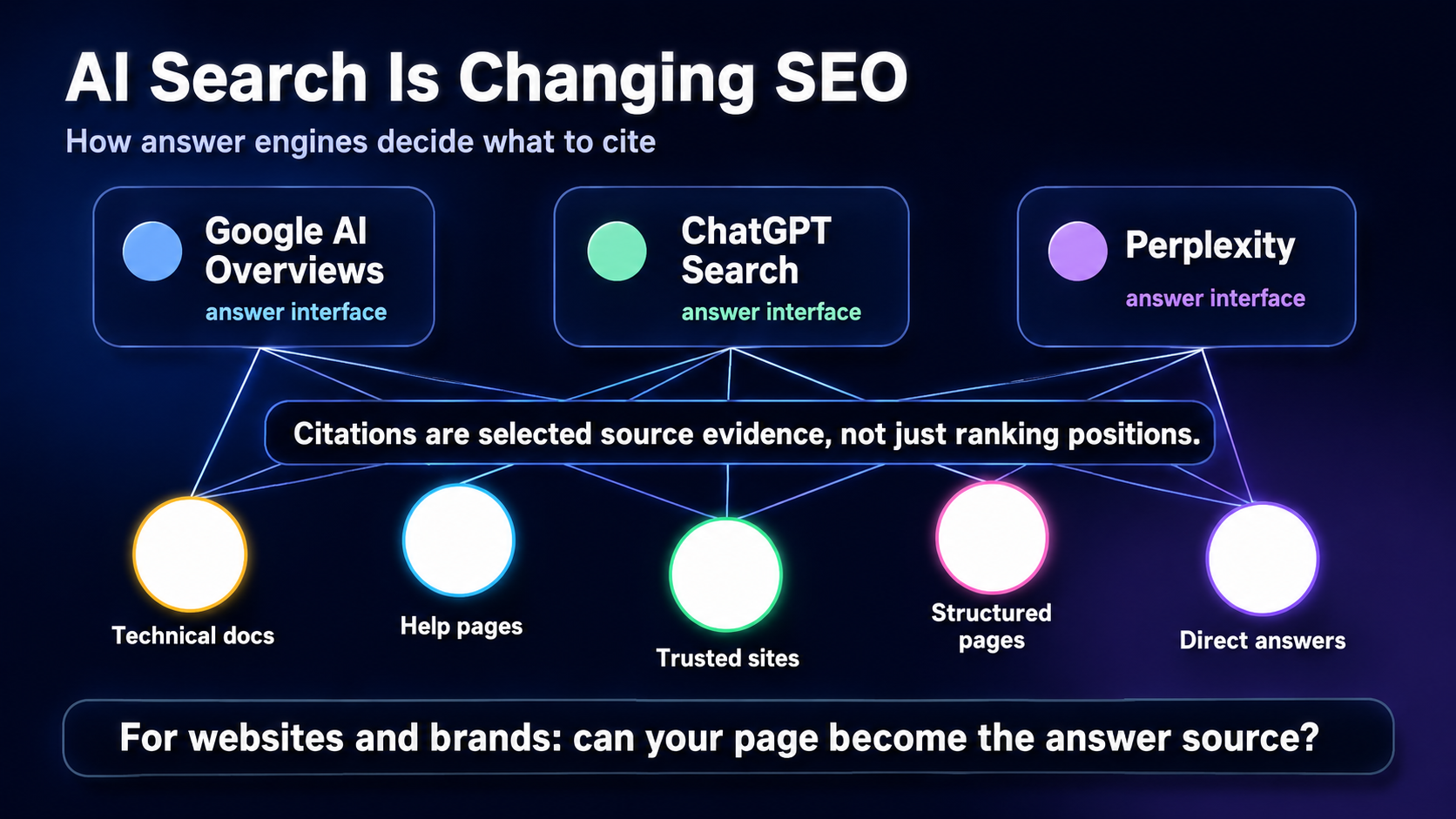
AI search changes the interface. Instead of showing ten blue links and asking the user to choose, systems such as Google AI Overviews, ChatGPT Search, and Perplexity generate an answer and attach source links or citations. The user may read the answer before deciding whether any website deserves a visit.
That changes the question for websites and brands. The old question was: can we rank? The new question is: can our page become the source evidence that an answer engine chooses to cite?
No public AI search product reveals a complete citation formula. Google, OpenAI, and Perplexity do not publish a single checklist that guarantees citation. But their public documentation and product behavior point to a practical pattern: pages are more likely to matter when they are relevant, accessible, structured, trustworthy, fresh when needed, and useful enough to support a specific answer.
In other words, AI search does not kill SEO. It changes the unit of visibility. SEO is still about pages, rankings, and clicks. AI search is increasingly about content blocks, source selection, claim support, and citation-worthy evidence.
What changed: from search results to answer results
Traditional search works like a menu. A user searches, sees options, reads snippets, and chooses a page. The ranking page is the interface. The website visit is where the real evaluation happens.
AI search works more like a first draft of an answer. The engine interprets the question, retrieves or references sources, synthesizes a response, and shows links or citations that support the answer. Sometimes those links become the only pages the user notices. Sometimes the user never clicks at all.
For brands, that means visibility is no longer only about being on page one. A page can rank well and still be ignored by an AI-generated answer. A page can be cited even when the user did not search for the exact keyword you targeted. Source selection can behave differently from traditional ranking.
This is why content teams need to think beyond keyword placement. They need to think about whether the page contains usable, specific, well-structured evidence. If the page is vague, thin, or hard to extract from, it may be a poor source even if it looks fine to a human visitor.
How Google AI Overviews approach sources
Google says its AI features, including AI Overviews and AI Mode, are part of Google Search from a site owner perspective. Its guidance emphasizes that website owners should keep following core search best practices: make content helpful, accessible, technically sound, and eligible for Search.
That matters because Google AI Overviews do not exist outside the search ecosystem. They are layered into it. Google can draw on web results, but the final AI Overview is not the same thing as a normal ranking list. It synthesizes information and shows source links that help users explore further.
For website teams, the practical lesson is not to chase a mystery AI loophole. The foundation is still sound SEO: crawlable pages, clear titles, relevant content, helpful explanations, and reliable site signals. But the content also needs to be answer-ready. Google AI Overviews are more likely to use pages that can support a clean answer to a specific query.
That means your page should not only say what your brand wants to say. It should answer the question the user actually asked. Definitions, comparisons, short explanations, clear headings, and supporting examples make a page more usable as source evidence.
How ChatGPT Search uses links and sources
OpenAI describes ChatGPT Search as a way to get fast, timely answers with links to relevant web sources. That phrasing matters. ChatGPT Search is not simply a chatbot guessing from memory. When a query needs fresh or web-grounded information, it can search and present source links so users can inspect the evidence behind the answer.
For brands, the implication is simple: the page must be useful enough to be selected in the retrieval process and clear enough to support the generated response. A page that hides the answer behind generic marketing copy gives the system less to work with. A page with direct explanations, specific facts, comparison sections, and visible source context is easier to use.
ChatGPT Search also reminds us that source links are part of trust. Users increasingly expect AI answers to show where information came from. If your content is cited, it can create brand visibility even when the user does not arrive through a traditional search result. If your content is not citation-worthy, your brand may disappear from the answer layer even if your website exists online.
The strongest pages for this environment are not just optimized for keywords. They are organized around questions, intent, and evidence. They make it easy for the system and the reader to understand what is true, what is opinion, and what action should come next.
How Perplexity thinks about answers and citations
Perplexity positions itself as an AI-powered answer engine that gives answers with source links. Its product experience is citation-first compared with many traditional search journeys: the user asks a question, receives a synthesized answer, and can inspect cited sources immediately.
This makes Perplexity especially important for publishers, software companies, consultants, and brands that rely on educational content. If Perplexity cites your article, guide, documentation, product comparison, or research page, your brand can appear inside the user journey earlier than it would in traditional search.
But the same rule applies: Perplexity cannot cite what it cannot retrieve, understand, or trust. Content needs to be accessible, specific, and useful. A generic landing page is usually weaker than a page that answers a question, shows examples, and provides context.
For citation-driven answer engines, the best website content often looks less like a brochure and more like a knowledge asset. It teaches, compares, defines, and supports claims. That is not only good for AI search. It is also better for human buyers who are trying to decide whom to trust.
The common citation signals across AI search systems
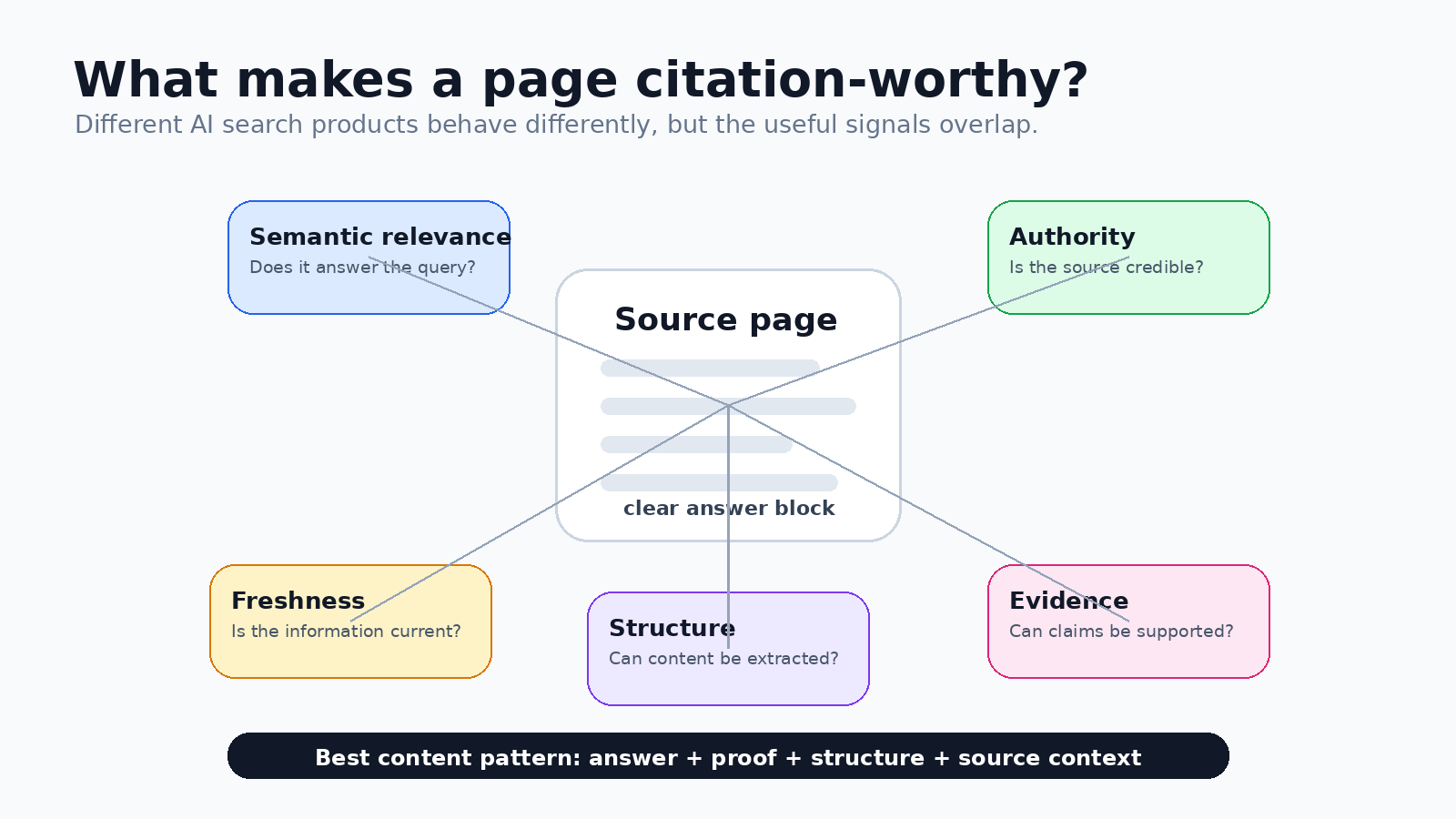
Every AI search system has its own retrieval and ranking pipeline. Still, a few practical signals appear again and again.
The first is semantic relevance. The page must match the user intent, not only the surface keyword. If the query asks how AI search engines decide what to cite, a page that directly explains citation logic will be more useful than a page that only says AI search is important.
The second is authority. This does not always mean a giant domain. It means the page has reasons to be trusted: expertise, evidence, original detail, clear authorship, official documentation, or a reputation for accuracy.
The third is freshness. Not every query needs new information, but AI search systems often handle timely questions. If the topic changes quickly, outdated content becomes weaker evidence.
The fourth is structure. AI systems work better with content that is easy to parse: headings, answer blocks, tables, definitions, lists, summaries, and clear page architecture.
The fifth is claim support. A page that makes bold claims without examples, numbers, sources, or context is less useful than a page that explains why the claim is true. For brands, this is the difference between marketing copy and citation-worthy content.
Signal | What it means | How to improve it |
Relevance | The page matches the user intent. | Answer one specific question clearly. |
Authority | The source appears credible. | Show expertise, proof, authorship, and sources. |
Freshness | The information is current enough. | Update fast-changing topics regularly. |
Structure | The answer can be extracted. | Use headings, tables, lists, and summaries. |
Support | Claims have evidence. | Add examples, data, documentation, or source links. |
Why AI citations matter for websites and brands
AI citations matter because they shift visibility from rankings to references. In traditional search, your brand wanted to be high on the results page. In AI search, your brand wants to become one of the sources the answer depends on.
That can create a new kind of authority. If your guide, report, documentation, or product page is repeatedly used as source evidence, your brand becomes part of how users understand the category. This is especially valuable for B2B companies, SaaS products, agencies, consultants, and publishers whose buyers research before they convert.
But there is also risk. If AI search answers summarize a category without citing your brand, users may never see you. If an answer cites outdated or weak sources, users may form opinions from incomplete evidence. If AI systems create zero-click answers, websites may lose traffic even when their content influenced the answer.
This is why brands need to track both search rankings and AI visibility. Rankings tell you where pages appear in traditional search. AI visibility tells you whether your content is being selected inside answer engines. The two are related, but they are not identical.
How to make content more citation-worthy
The practical work is not complicated, but it requires discipline. Start by identifying the questions your audience asks before they buy, compare, or trust. Then build pages that answer those questions directly.
Each important page should include a clear definition, a short summary, deeper explanation, examples, comparison tables when useful, and a final next step. If you make claims, support them. If the topic changes, update the page. If your point of view is original, make it explicit.
Do not hide the best information inside vague paragraphs. Use headings that make sense without the surrounding text. Use tables to compare. Use FAQs to answer specific questions. Use source links where they strengthen trust. Use schema and technical SEO where appropriate, but do not confuse technical decoration with actual usefulness.
Finally, connect citation visibility to business action. If an AI answer sends a user to your page, the page still needs to convert. Make the offer clear. Show proof. Explain the next step. AI search may change how people arrive, but it does not remove the need for trust.
Final takeaway
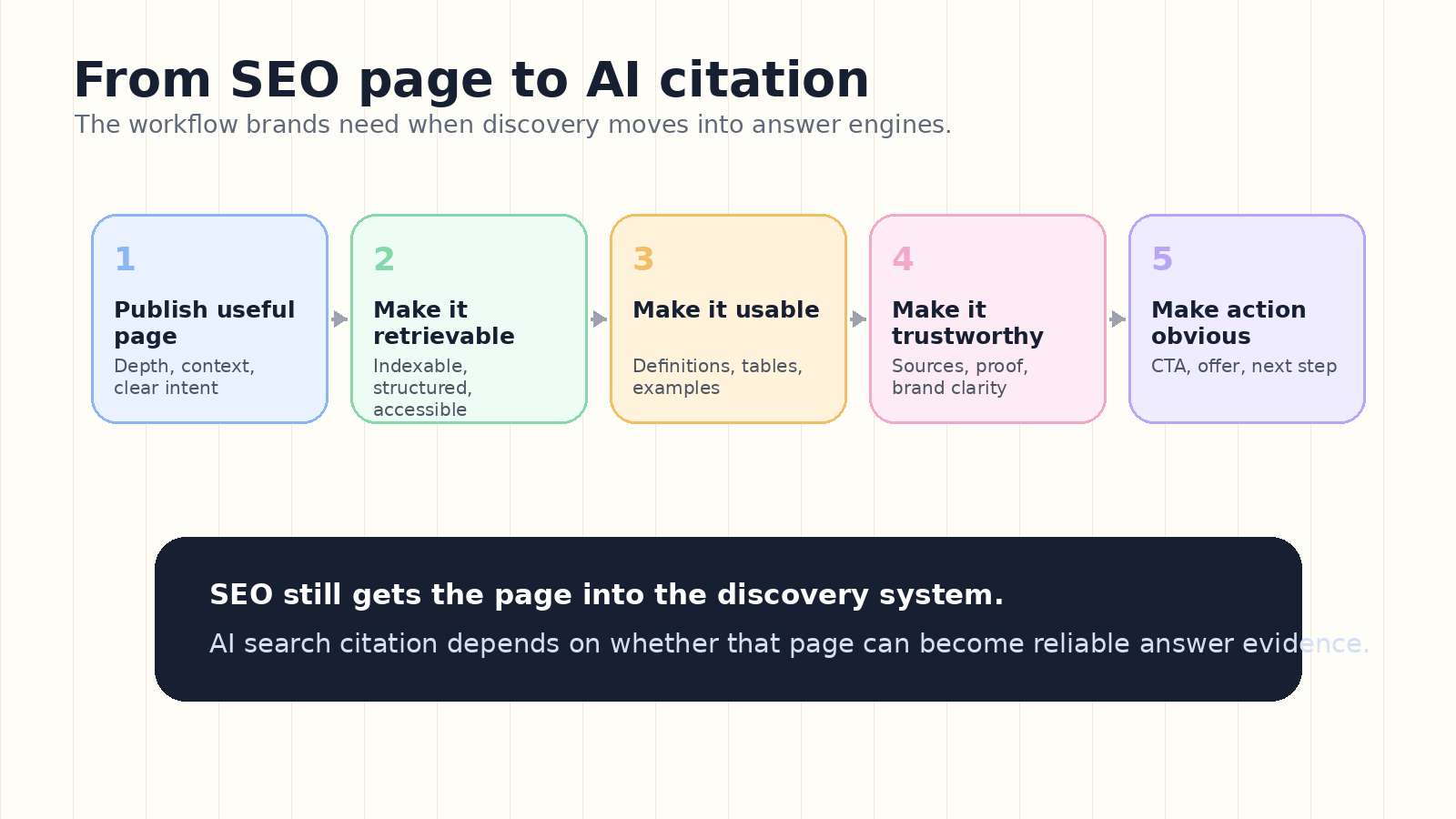
AI search is changing SEO because discovery is becoming more answer-driven. Google AI Overviews, ChatGPT Search, and Perplexity do not only surface pages. They synthesize answers and attach sources.
That means websites and brands must optimize for more than rankings. They need content that is easy to retrieve, easy to understand, easy to verify, and useful enough to cite.
The best strategy is not to abandon SEO. It is to expand it. Keep the technical and content foundations of SEO, then add the GEO mindset: make every important page answer-ready, evidence-rich, structured, current, and clear.
In the new search environment, the most valuable page is not just the page that ranks. It is the page that becomes the evidence behind the answer.
CTA
If your website is still built only for old search rankings, start upgrading your best pages for AI search visibility. Make them clearer, better structured, better supported, and easier to cite.
The future of SEO is not just being found. It is becoming the source that answer engines trust enough to reference.
FAQ
How is AI search changing SEO?
AI search changes SEO by moving part of discovery from ranked links to generated answers with citations. Websites now need to rank and also become useful source evidence.
How does Google AI Overviews decide what to cite?
Google does not publish a complete citation formula. Its public guidance points website owners back to strong search fundamentals: helpful, accessible, reliable, and well-structured content.
How does ChatGPT Search choose sources?
OpenAI says ChatGPT Search can provide timely answers with links to relevant web sources. For brands, that means content must be retrievable, relevant, and useful enough to support an answer.
How does Perplexity decide what to cite?
Perplexity operates as an answer engine with cited sources. Content that is clear, credible, current, and directly useful to the question is generally more citation-ready.
What should websites do now?
Improve important pages with direct answers, strong headings, examples, sources, comparison tables, freshness, and a clear conversion path.
Related Tools
- ChatGPT
- Ahrefs
- Semrush
Sources