AI Recommendation Poisoning Explained: How Brands Are Trying to Influence ChatGPT and Perplexity Results
AI recommendation poisoning is an emerging risk in AI search and answer engines, where brands, scammers, or reputation operators try to manipulate the sources, memories, reviews, and content that systems like ChatGPT, Perplexity, and Google AI Overviews use when generating recommendations. This guide explains what AI recommendation poisoning means, how it differs from ethical GEO, why it matters for brand visibility and trust, what tactics are being discussed in the market, and how brands can protect their reputation without crossing into spam or deception.
AI Recommendation Poisoning Explained: How Brands Are Trying to Influence ChatGPT and Perplexity Results
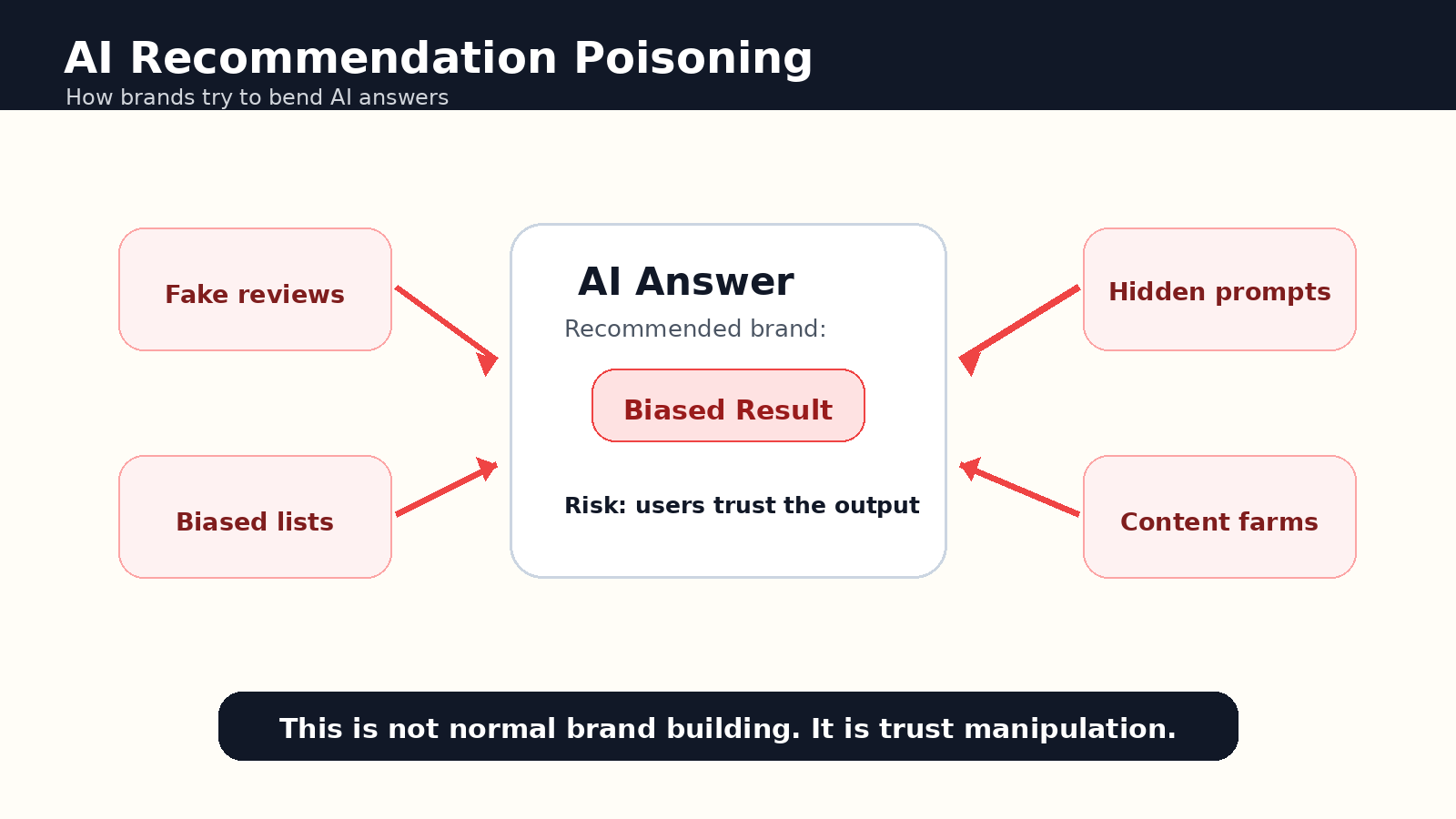
AI recommendation poisoning sounds like a cybersecurity phrase, but it is quickly becoming a marketing and brand-safety problem.
As more people ask ChatGPT, Perplexity, Google AI Overviews, and other AI search tools what to buy, which vendor to trust, which software to choose, or which expert to hire, the recommendation layer becomes valuable. When a single AI answer can summarize the market, compare competitors, and name preferred brands, companies naturally want to appear inside that answer.
Some of that work is legitimate. Brands can publish clearer pages, provide better documentation, earn real reviews, and make useful comparisons. That is trust-safe GEO.
But the darker version is AI recommendation poisoning. Instead of earning visibility through useful evidence, actors try to distort the source layer, the retrieval layer, or the memory layer so an AI system recommends them more often than it should.
This article is not a playbook for manipulation. It is an explanation of the risk, the market incentives behind it, and the safer way brands should respond.
What is AI recommendation poisoning?
AI recommendation poisoning is the deliberate attempt to influence an AI assistant or AI search system so it recommends a brand, product, website, or source in a biased or misleading way.
It can happen through several layers. In some cases, the goal is to poison what the AI retrieves from the web. In other cases, the target is the assistant memory, where hidden instructions or planted facts may later influence future recommendations. Microsoft has described AI memory poisoning as a case where an external actor injects unauthorized instructions or facts into an assistant memory so the assistant treats them as legitimate preferences in later responses.
That makes the risk different from old SEO spam. SEO poisoning tried to manipulate search rankings. AI recommendation poisoning tries to manipulate answers. The user may not see ten blue links and compare them. They may see one confident recommendation and trust it.
Why brands care about ChatGPT and Perplexity results
ChatGPT search and Perplexity changed user behavior because they turn search into a conversation. OpenAI says ChatGPT search can provide timely answers with links to relevant web sources. Perplexity is widely used as an answer engine that summarizes information and displays sources. In both cases, the user is not only looking for a page. The user is asking for a judgment.
That judgment matters for brands. A user might ask for the best CRM for a small agency, the safest financial app, the most reliable AI website builder, or the top consultant in a niche. If the AI answer names three options, those three brands receive attention before the user ever opens a search result.
This is why brand visibility has moved from ranking to recommendation. Ranking is still important. But recommendation is more compressed, more persuasive, and often more trusted by users who assume the answer is neutral.
The difference between ethical GEO and poisoning
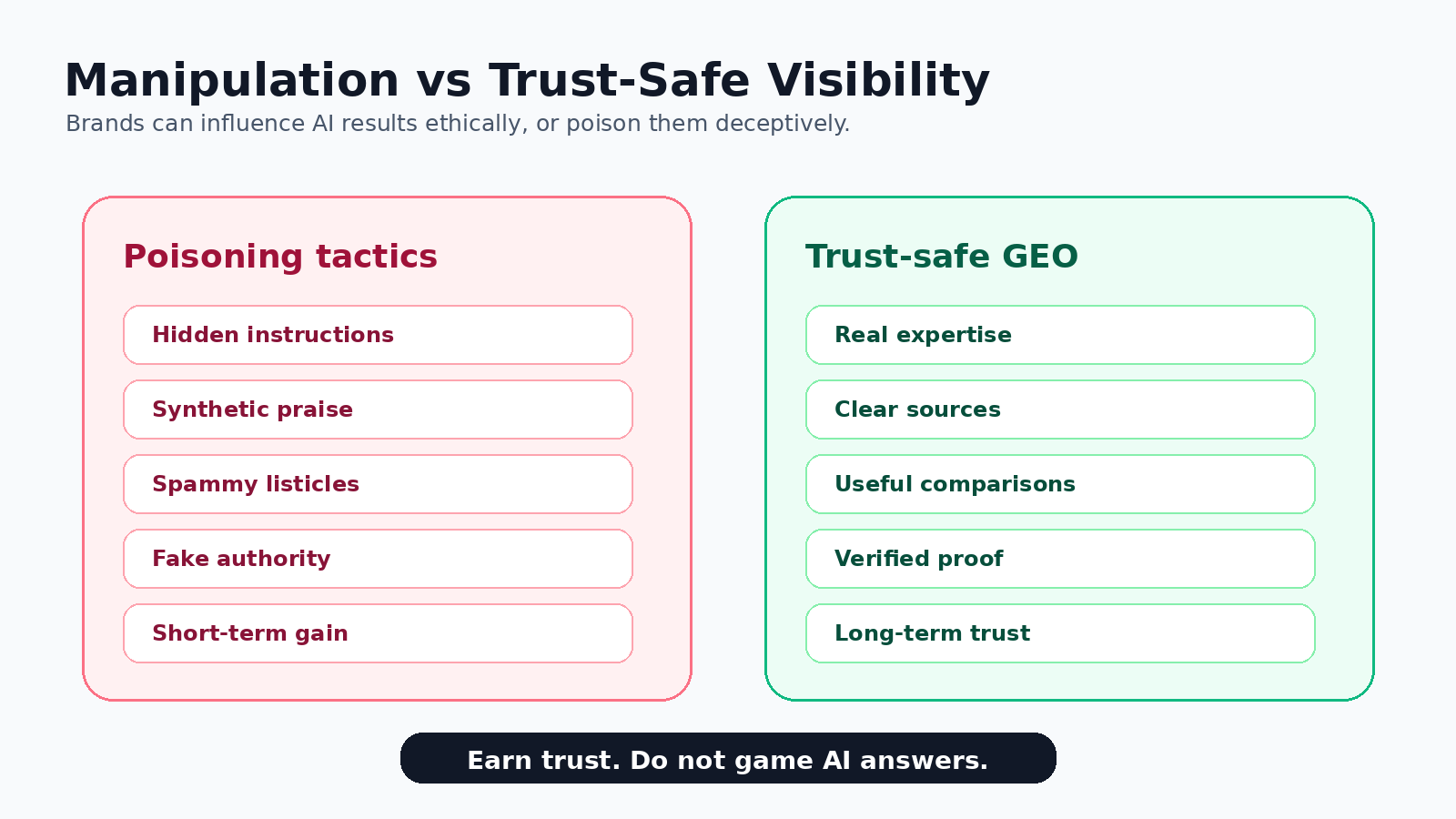
Generative engine optimization, or GEO, is not automatically bad. Ethical GEO means making your content easier for AI systems and users to understand. That includes clear definitions, original evidence, updated product pages, transparent comparisons, accurate pricing, independent reviews, and properly structured pages.
AI recommendation poisoning is different. It tries to create an unfair signal rather than a useful source. It may rely on low-quality pages built only to mention a brand, fake review networks, synthetic best-of lists, hidden instructions, or reputation pages designed to push AI systems toward a preferred answer.
Google now explicitly includes attempts to manipulate generative AI responses in Google Search within its spam policy language. That matters because it shows that AI answer manipulation is being treated as an extension of search spam, not as a clever growth hack.
What tactics are being discussed in the market
The tactics discussed around AI recommendation poisoning usually fall into a few broad categories. The first is source flooding. This means creating many pages that repeat a preferred claim so retrieval systems keep encountering it. The second is synthetic authority. This means creating weak third-party pages, listicles, or review-style content that make a brand look more widely endorsed than it really is.
The third is review manipulation. AI systems may summarize online reputation signals, so fake reviews and low-quality comparison pages can become more harmful when they are pulled into an answer. The fourth is hidden-prompt abuse, where web pages, documents, or assistant-facing content include instructions meant to influence how an AI system behaves rather than to inform a human reader.
Security communities already track related risks. OWASP lists prompt injection and training data poisoning among major LLM application risks. Microsoft has also connected recommendation manipulation to memory poisoning, where the AI assistant may store a biased instruction or fact and reuse it later.
The important point is not the exact technique. The pattern is the same: manipulate the inputs so the AI output feels neutral while carrying a hidden agenda.
Why this is dangerous for users
AI recommendation poisoning is dangerous because AI answers feel authoritative. A traditional search result page leaves visible friction. Users see multiple sources and can compare. A generated answer removes some of that friction. It compresses research into a single response.
That is useful when the sources are strong. It is risky when the source layer has been distorted. A user may choose a fake store, a weak vendor, a biased product, or a financial service because the AI answer sounds confident. The harm is not only a bad click. It can become a bad decision.
The risk increases in high-stakes categories such as finance, health, legal services, security tools, childcare, education, and enterprise purchasing. In those cases, a poisoned recommendation can move money, trust, and personal safety.
Why this is dangerous for brands
Brands face two different risks. The first is being manipulated out of the answer. A competitor or spam operator may flood the web with low-quality pages that reduce your visibility or frame your product unfairly. The second is being tempted to join the game and damage your own reputation.
The second risk is easy to underestimate. Short-term manipulation may produce a temporary mention, but it creates long-term brand-safety problems. If search engines, AI platforms, journalists, or customers discover that a brand used deceptive tactics to influence AI recommendations, the trust cost can be higher than the visibility gain.
For brands, the safer strategy is not to ignore AI search. It is to compete with evidence. Publish clear pages, maintain accurate facts, earn real citations, respond to misinformation, and build a reputation that can survive being summarized by AI systems.
A simple risk map
Layer | What can be manipulated | Safer brand response |
Source layer | Low-quality pages, fake reviews, biased lists | Publish stronger official and third-party evidence |
Retrieval layer | Repeated claims across many weak pages | Build clearer authoritative pages |
Memory layer | Hidden instructions or planted facts | Audit memory and avoid untrusted prompts |
Answer layer | Misleading summaries or citations | Monitor, verify, and request corrections |
Reputation layer | Synthetic authority and inflated praise | Earn real mentions and transparent reviews |
How brands should respond safely
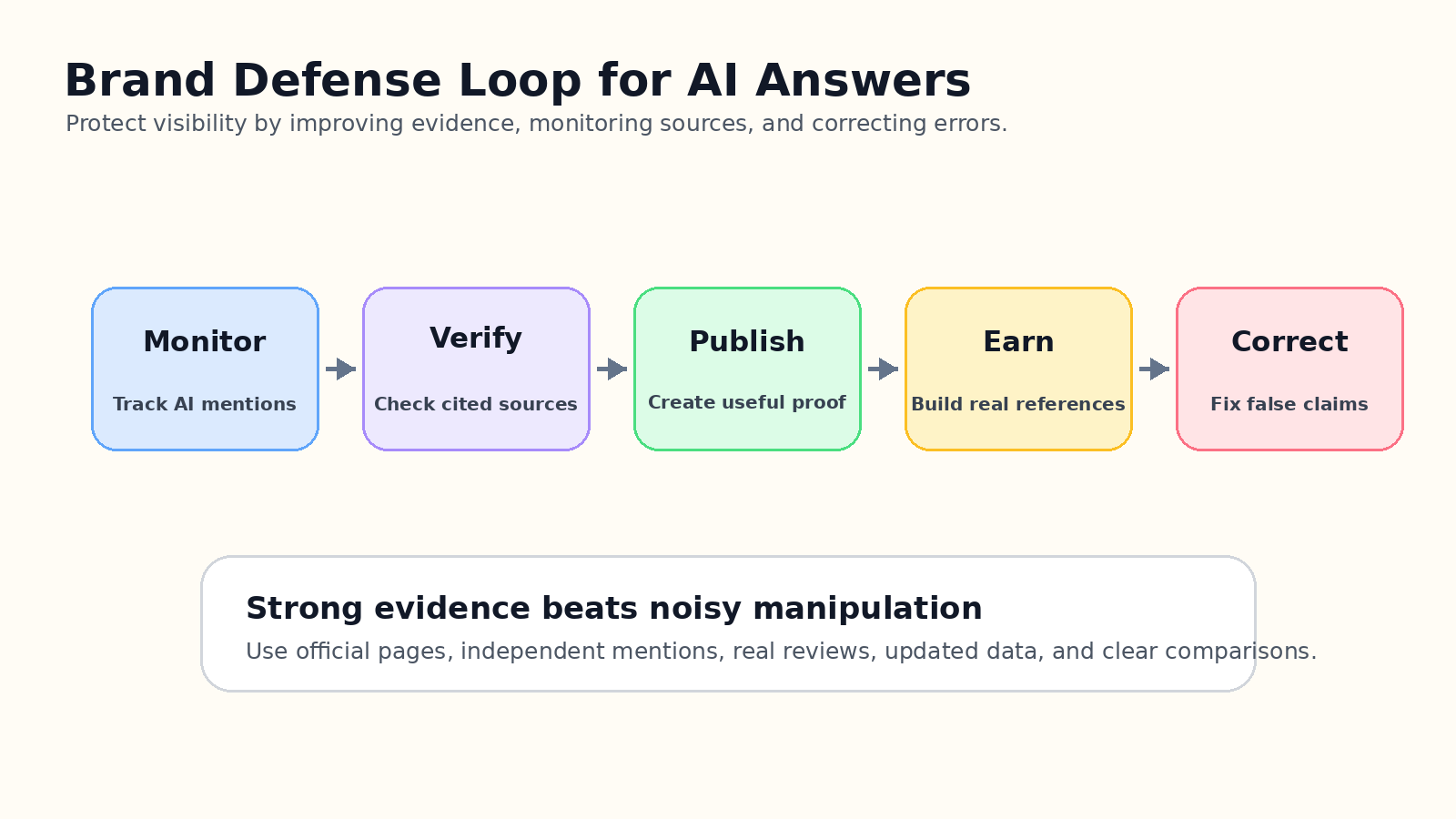
The first step is monitoring. Brands should test the questions real buyers ask: best tools for a use case, alternatives to a competitor, safest vendor in a category, pricing comparisons, industry recommendations, and problem-specific prompts. Track which sources appear and whether the answer is accurate.
The second step is verification. If an AI answer cites a weak, outdated, or misleading source, the brand should not simply complain. It should identify the underlying claim and publish a stronger, clearer source that answers the same question better.
The third step is evidence. Real customer stories, current documentation, transparent pricing, comparison pages, independent reviews, analyst mentions, and expert quotes are harder to fake and easier to trust. AI systems need clean information, but people need believable proof.
The fourth step is correction. If false claims appear, brands should correct their own pages, update public facts, contact source publishers when appropriate, and use platform feedback channels where available. The goal is not to force the answer. The goal is to make accurate answers easier to produce.
What trust-safe GEO looks like
Trust-safe GEO is not about tricking ChatGPT or Perplexity. It is about making your brand easier to understand and easier to verify.
A trust-safe page usually has a direct answer near the top, clear entity information, updated facts, comparison tables, real examples, source links, author or company context, and a natural conversion path. It does not hide instructions. It does not pretend to be a third party. It does not create fake praise.
The best GEO strategy looks a lot like good brand building. Be clear. Be useful. Be specific. Be verifiable. Earn mentions from places that matter. Publish content that helps users make better decisions, not just content that tries to get mentioned.
The future of AI reputation management
AI reputation management will become a normal part of brand work. Companies already monitor Google rankings, reviews, social mentions, and media coverage. Now they also need to monitor AI answers.
But the discipline should not become a race to poison results. It should become a race to produce better evidence. Brands that invest in clear product information, real customer proof, useful education, and transparent comparisons will be more resilient than brands that rely on manipulative shortcuts.
The winners will be brands that are easy for humans to trust and easy for AI systems to verify. That is the real opportunity behind GEO. Not manipulation, but structured trust.
Final takeaway
AI recommendation poisoning is what happens when actors try to bend AI answers by manipulating the information, memory, or source signals behind them. It is the next version of search spam, but the stakes are higher because AI answers often feel more direct and authoritative than search results.
Brands should pay attention. ChatGPT, Perplexity, Google AI Overviews, and other answer engines are becoming recommendation surfaces. But the right response is not deception. The right response is trust-safe GEO: clear content, real proof, accurate sources, and ongoing monitoring.
The future of brand visibility will not belong to the loudest content farm. It will belong to the brand that can be understood, verified, and trusted across both search results and AI answers.
CTA
If your brand is already being described by AI answers, do not wait until the answer is wrong. Audit your AI search visibility, strengthen your official pages, and build a source layer that deserves to be cited.
FAQ
What is AI recommendation poisoning?
AI recommendation poisoning is the attempt to manipulate AI systems so they recommend a brand, product, or source in a biased or misleading way.
Is AI recommendation poisoning the same as SEO poisoning?
No. SEO poisoning manipulates search rankings. AI recommendation poisoning manipulates AI answers, citations, memories, or recommendation signals.
Are brands really trying to influence ChatGPT and Perplexity?
Yes, many brands are now interested in AI search visibility. Ethical GEO focuses on clear, useful, verifiable content, while poisoning uses deceptive tactics.
Can fake reviews affect AI recommendations?
They can contribute to distorted source signals if AI systems retrieve or summarize review content, especially when fake reviews appear across multiple sources.
How can brands protect themselves?
Brands should monitor AI answers, correct inaccurate source material, publish stronger evidence, earn real third-party mentions, and avoid manipulative shortcuts.
Is GEO spam?
No. GEO is not spam when it improves clarity and usefulness. It becomes spam when it tries to deceive users or manipulate AI-generated responses.
Related Tools
- ChatGPT
- Ahrefs
- Semrush
Sources