AI Agent Complete Guide: Why Every Tool Is Becoming an Agent in 2026
AI agents are changing what software is supposed to do. Instead of waiting for users to click every button, modern tools are becoming agentic systems that can understand goals, call tools, use context, complete multi-step workflows, and help businesses turn work into outcomes. This complete guide explains what AI agents are, why every major tool category is moving toward agents in 2026, and how agentic workflows are changing productivity, websites, content, sales, customer support, operations, and growth. You will learn the difference between a chatbot, an automation, and an AI agent, what makes agents useful, where they fail, and how businesses should prepare for the agent-first software era. The article also explains why websites still matter in an agent-driven world: they are becoming structured knowledge sources that help humans, search engines, and AI agents understand what a business offers.
AI Agent Complete Guide: Why Every Tool Is Becoming an Agent in 2026
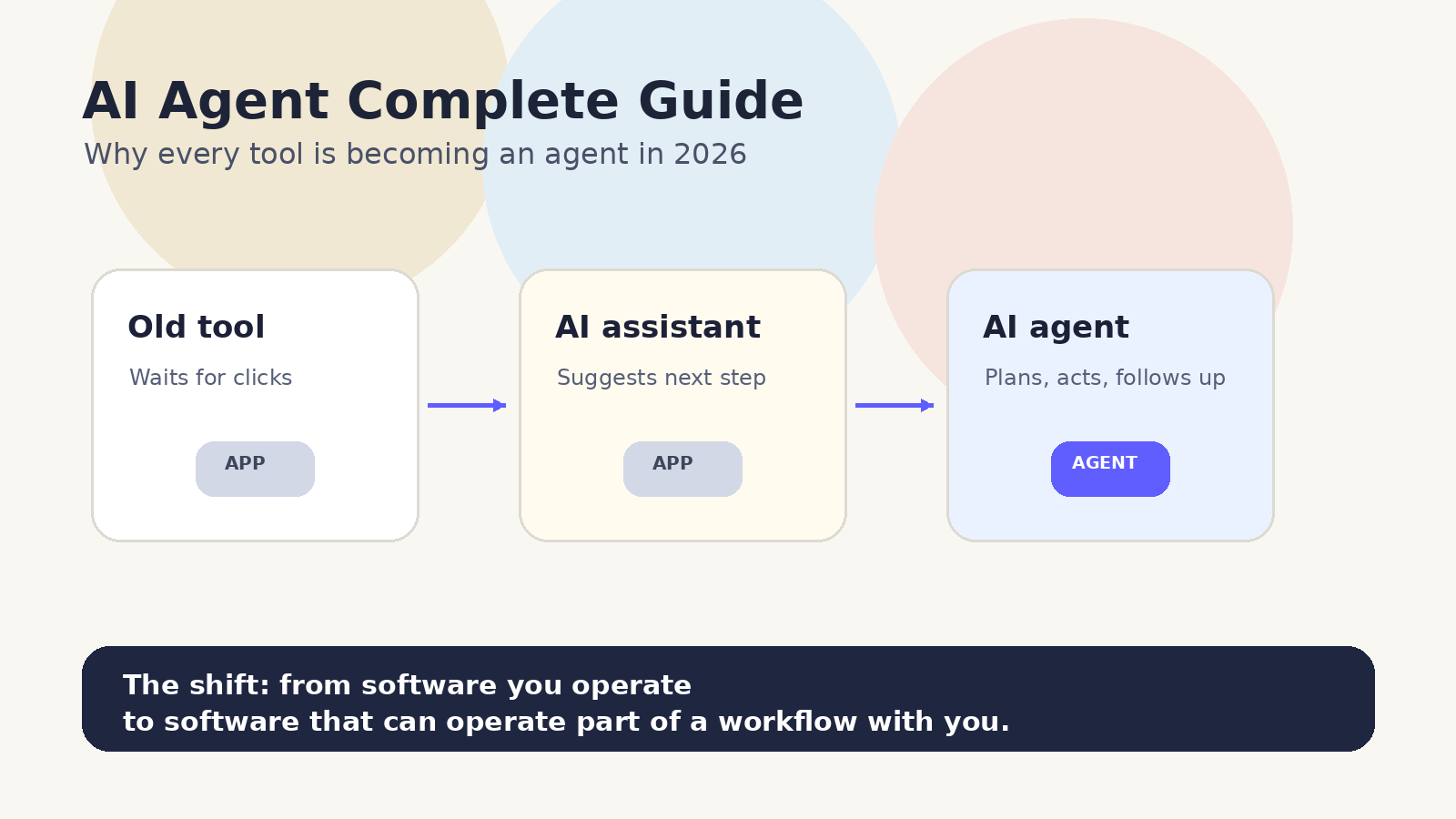
Image 1: From tools to agents
A few years ago, every product wanted to be “AI-powered.” In 2026, that label is not enough anymore.
The new race is different: every tool wants to become an agent.
Not just a chatbot inside a sidebar. Not just a button that writes a paragraph. A real agent is something more useful. It can understand a goal, decide what steps are needed, call tools, check results, and keep moving until the work is done.
That is the big shift. Software is moving from “you operate the tool” to “the tool operates part of the workflow with you.”
What is an AI agent?
An AI agent is a system that can take instructions, reason through a task, use tools, and complete work across multiple steps. It is usually powered by a language model, but the model alone is not the whole agent.
A normal AI assistant might answer a question. An agent tries to do something with that answer.
For example, a chatbot can tell you how to write a sales email. An agent can draft the email, find the lead context, personalize the message, send it through the right tool, and remind you if there is no reply.
That difference sounds small, but it changes the entire software market.
Chatbot vs automation vs AI agent
Type | What it does | Strength | Limit |
Chatbot | Responds to prompts | Fast answers | Often waits for every instruction |
Automation | Runs fixed rules | Reliable repetition | Breaks when context changes |
AI agent | Plans and uses tools | Handles changing workflows | Needs guardrails and clear goals |
The best way to understand agents is this: chatbots talk, automations repeat, agents work through a goal.
Why every tool is becoming an agent
The reason is simple. Most tools are useful, but they still create work. You open the tool. You upload the file. You choose the template. You write the prompt. You copy the result. You paste it somewhere else. You check if it worked.
That was acceptable when software only promised efficiency. But AI raises the expectation. Once a user sees a tool understand intent, the next question is obvious: why can’t it finish the job?
So product categories are changing. CRMs are becoming sales agents. Support platforms are becoming resolution agents. Design tools are becoming creative agents. Developer tools are becoming coding agents. Website builders are becoming growth agents. Search tools are becoming research agents.
The interface is no longer the main product. The workflow is becoming the product.
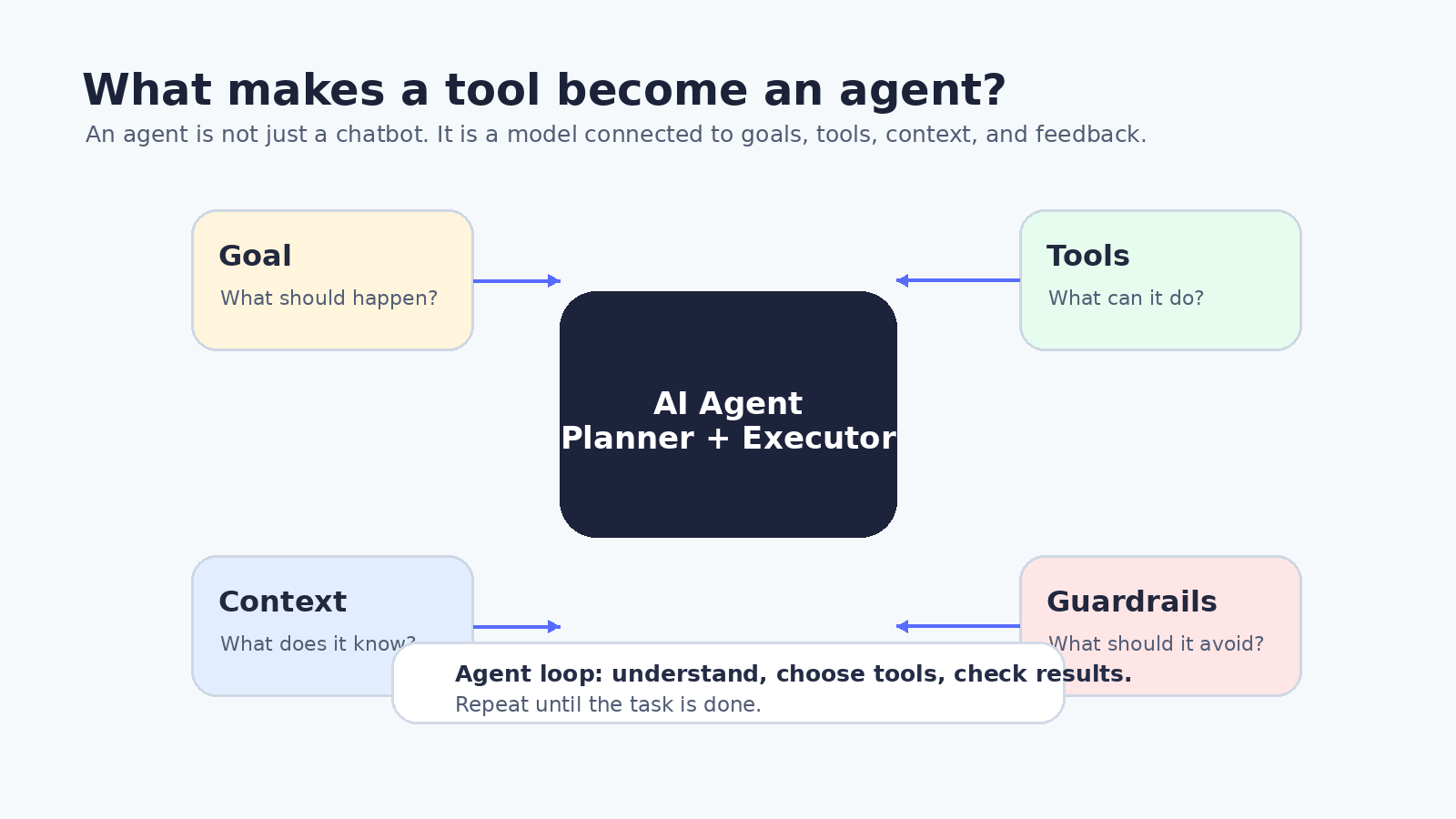
Image 2: Basic AI agent architecture
The basic structure of an agent
Most useful agents are built from the same basic parts.
A goal: what the user wants to accomplish.
A model: the reasoning layer that interprets the goal.
Tools: external actions such as search, code execution, database access, email, calendar, CMS, analytics, or design systems.
Context: business data, files, memory, brand voice, product details, and user preferences.
Guardrails: rules that prevent unsafe, incorrect, or unwanted actions.
Feedback: signals that tell the agent whether the output worked.
This is why tool calling and protocols matter. A model without tools can explain. A model with tools can act. A model with tools, context, and feedback can become a workflow system.
Why agents are becoming a product strategy
For software companies, agents are not just a feature. They are a new product strategy.
A traditional tool competes on features. An agent competes on outcomes. Instead of saying “we have a dashboard,” the product can say “we will monitor the signal and tell you what to do next.” Instead of saying “we have templates,” it can say “we will create the first draft, adapt it to your goal, and publish it.”
This is why the agent trend feels bigger than a normal AI feature cycle. It changes the user promise. The product is not only helping you work faster. It is taking responsibility for more of the work.
Where agents are showing up first
Agents are appearing fastest in workflows where three things are true: the task is repetitive, the context changes often, and the output can be checked.
Coding: agents can inspect files, write code, run tests, and fix errors.
Research: agents can search, compare sources, summarize, and build briefs.
Sales: agents can qualify leads, draft outreach, and update CRM fields.
Customer support: agents can answer, escalate, and resolve common issues.
Marketing: agents can generate campaigns, analyze performance, and suggest next steps.
Websites: agents can help structure pages, optimize content, and connect visibility to leads.
Not every task should be fully autonomous. But many tasks can become partially agentic, where the tool does the heavy lifting and the human approves the important decisions.
Why websites still matter in an agent-first world
Some people assume agents will make websites less important. That is probably the wrong conclusion.
Agents need structured information. They need to understand what a company does, who it serves, what proof exists, what actions users can take, and why the business should be trusted. A messy website makes that harder. A clear showcase website makes it easier.
This is where the idea of an AI-ready showcase website matters. A good website is no longer just a digital brochure. It becomes a structured source of truth for customers, search engines, and AI systems.
For a founder, creator, consultant, agency, or small business, the site should answer three questions quickly: what do you offer, why should I trust you, and what should I do next?
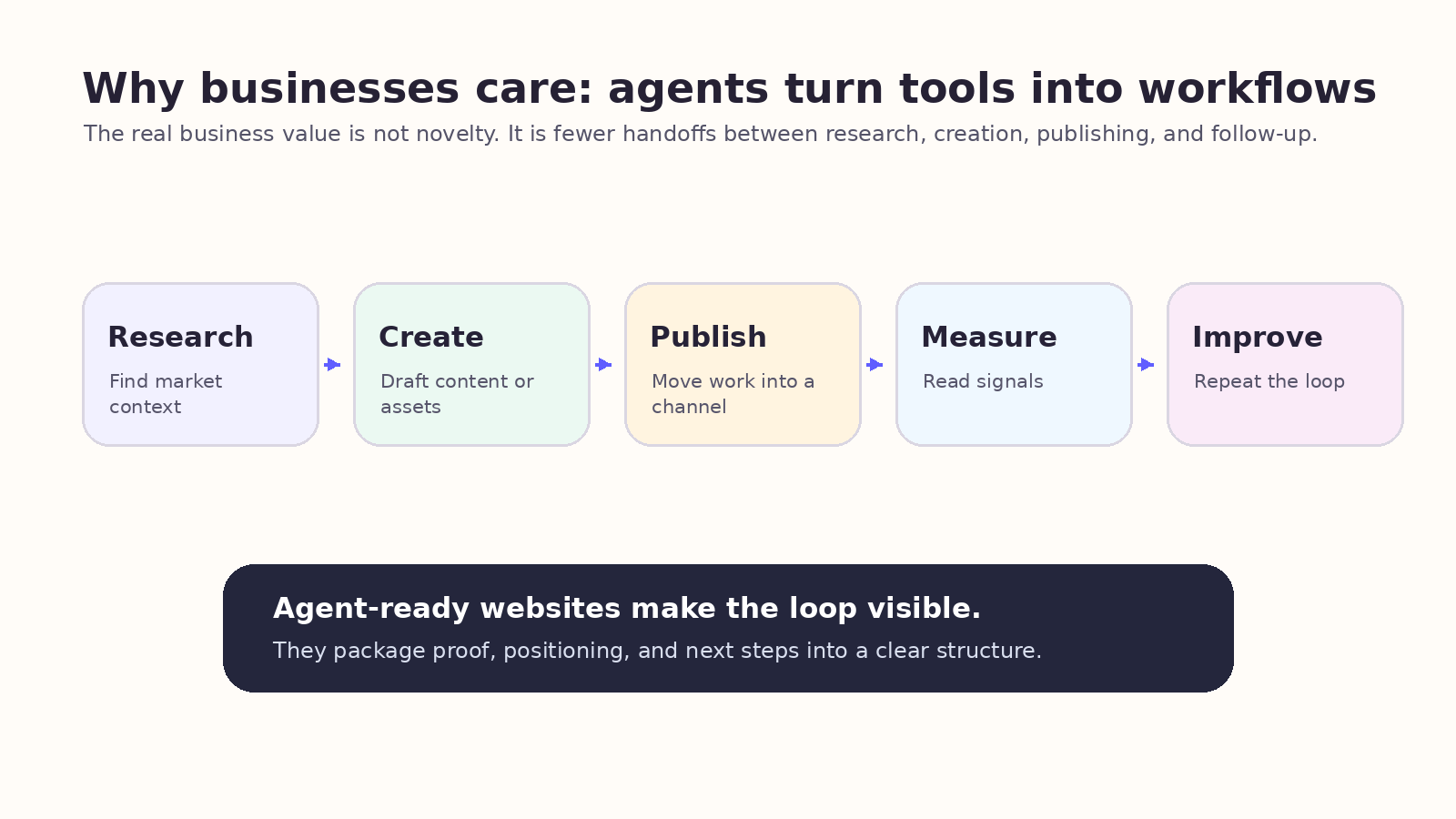
Image 3: Agent-ready growth loop
How this connects to growth
The business value of agents is not that they feel futuristic. The value is that they reduce the gap between intent and action.
A visitor wants to understand your service. A search engine wants to classify your page. An AI assistant wants to summarize your offer. A potential customer wants proof. A team member wants to publish faster. Agents can help move all of those steps closer together.
This is also where platforms like We0.ai fit naturally, as long as the story is not reduced to “AI builds a page.” The more important idea is that a website should be built as a growth asset: structured, clear, searchable, AI-readable, and designed to turn attention into leads.
The chain is simple: build the site, showcase the value, grow through search and AI discovery, then convert that attention into leads.
What can go wrong with agents?
Agents are powerful, but they are not magic. In fact, bad agents can create more work than they remove.
They can misunderstand vague goals.
They can call the wrong tool.
They can produce confident but incorrect outputs.
They can expose data if permissions are not designed carefully.
They can create messy workflows if no one defines the handoff between human and agent.
This is why the next wave of AI products will not only be about intelligence. It will be about reliability, permissions, context, and user control.
How to prepare your business for agents
You do not need to rebuild everything at once. Start with the workflows where agents can remove friction without creating too much risk.
Document repeated workflows.
Clean up the content and data agents will use.
Create clear approval points.
Turn vague tasks into structured steps.
Make your website and public pages easier for both humans and AI systems to understand.
Measure outcomes, not just AI usage.
The companies that benefit most from agents will not be the ones that add the most AI buttons. They will be the ones that redesign workflows around clear outcomes.
Final thought
Every tool is becoming an agent because users no longer want software that only stores work. They want software that moves work forward.
That does not mean humans disappear from the process. It means humans move closer to judgment, direction, and taste, while agents take on more research, formatting, routing, and follow-up.
The future of software is not just more automation. It is goal-driven collaboration between people, tools, and AI systems.
And for businesses, the practical question is simple: is your workflow ready for agents, and is your website structured enough for agents to understand you?
CTA
If your website still works like a static brochure, it may not be ready for the agent-first web.
Build a clearer showcase website with We0.ai: https://we0.ai
FAQ
What is an AI agent?
An AI agent is a system that can understand a goal, use tools, and complete multi-step tasks with some level of autonomy.
How is an AI agent different from a chatbot?
A chatbot mainly responds to prompts. An agent can take actions, call tools, and continue a workflow.
Why are tools becoming agents?
Because users want outcomes, not just interfaces. Agents help software move from passive tools to active workflow systems.
Are AI agents safe for business use?
They can be useful, but they need permissions, guardrails, human review, and clear workflow design.
Do websites matter if agents answer questions?
Yes. Agents need structured sources of truth. A clear website helps both humans and AI systems understand a business.